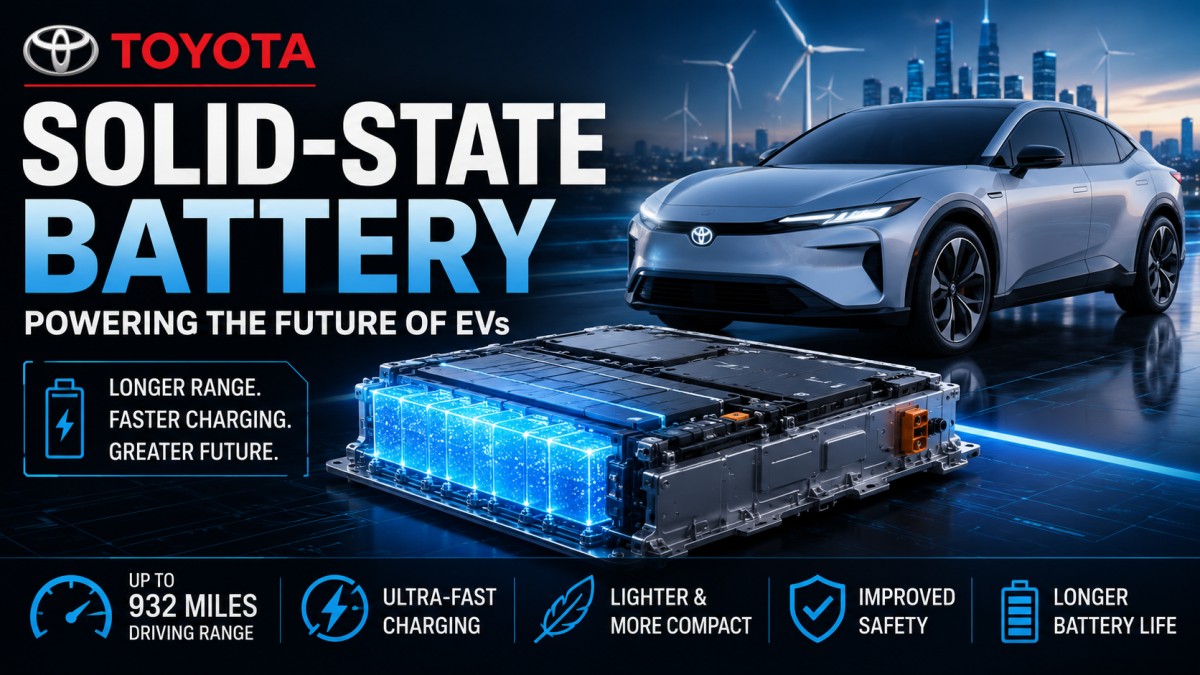
Toyota Solid-State Battery Could Redefine the Future of Electric Vehicles
The electric vehicle (EV) industry is entering one of its most important phases, and Toyota believes the next major breakthrough will come not from better motors or sleeker vehicle designs, but from a completely new generation of battery technology. After years of research and development, the Japanese automaker is moving closer to introducing solid-state batteries, a technology that many experts consider the future of electric mobility.
While many manufacturers rapidly expanded their battery-electric vehicle lineups over the past decade, Toyota followed a different strategy. The company continued investing heavily in hybrid vehicles while quietly researching advanced battery technologies behind the scenes. Now, that patient approach could give Toyota a significant advantage if solid-state batteries achieve commercial success.
Unlike conventional lithium-ion batteries that power nearly every modern EV today, solid-state batteries promise longer driving range, dramatically faster charging, improved safety, lighter weight, and greater energy density. If these promises become reality at scale, they could reshape the global automotive industry.
Toyota’s Different Approach to Electrification
Toyota has often faced criticism for not introducing fully electric vehicles as quickly as several competitors. However, the company’s leadership repeatedly explained that electrification should follow multiple pathways rather than relying entirely on battery-electric vehicles.
Instead of rushing into mass EV production, Toyota expanded its hybrid lineup, improved plug-in hybrid technology, continued hydrogen fuel-cell development, and invested billions into next-generation battery research.
This strategy allowed Toyota to maintain profitability while investing in technologies designed to solve the biggest challenges facing electric vehicles.
The company now believes its years of research have brought solid-state batteries significantly closer to commercial production than ever before.
Why Lithium-Ion Batteries Have Limits
Lithium-ion batteries transformed the automotive industry by making modern electric vehicles practical. They offer high energy density, reliable performance, and steadily declining production costs.
However, they still present several limitations that continue to influence consumer buying decisions.
Current lithium-ion batteries typically face challenges such as:
- Limited driving range compared to gasoline vehicles
- Long charging times during road trips
- Significant battery weight
- Gradual degradation after repeated fast charging
- Higher cooling requirements during heavy use
Although lithium-ion technology continues improving every year, many industry experts believe future performance gains will become increasingly difficult without a major technological breakthrough.
That is where solid-state batteries enter the conversation.
What Makes Solid-State Batteries Different?
Traditional lithium-ion batteries use a liquid electrolyte to move lithium ions between the battery’s positive and negative electrodes.
Solid-state batteries replace this liquid electrolyte with a solid material.
While the concept appears simple, it creates several potential advantages.
The solid electrolyte allows engineers to increase energy density while reducing battery size and weight. It also has the potential to improve thermal stability, making batteries less susceptible to overheating.
Because of these characteristics, many researchers consider solid-state technology the next evolutionary step in electric vehicle battery development.
Longer Driving Range Could Change Everything
Perhaps the biggest attraction of Toyota’s future solid-state batteries is their projected driving range.
Toyota has indicated that future solid-state battery vehicles could potentially travel between 745 and 932 miles (approximately 1,200 to 1,500 kilometers) on a single charge under ideal conditions.
If achieved in real-world production vehicles, this would represent one of the largest improvements in EV history.
Such extended range could dramatically reduce range anxiety, one of the biggest concerns among prospective electric vehicle buyers.
Long-distance travelers would require far fewer charging stops, making electric vehicles more practical for vacations, business travel, and rural driving.
For many consumers, an EV capable of traveling hundreds of additional miles between charges could eliminate one of the final barriers preventing adoption.
Smaller Batteries, Bigger Benefits
Solid-state batteries are expected to deliver more energy while occupying less physical space.
This provides several important advantages for vehicle manufacturers.
A smaller battery pack allows engineers to redesign vehicle platforms more efficiently, creating additional passenger room and larger cargo areas.
Reduced battery weight also improves overall vehicle dynamics.
Lighter vehicles generally accelerate more efficiently, consume less energy, improve braking performance, and reduce tire wear.
Commercial vehicles may also benefit from increased payload capacity because less vehicle weight is dedicated to the battery system.
These advantages extend beyond performance—they also improve overall efficiency throughout the vehicle.
Faster Charging Could Transform Daily EV Ownership
Charging speed remains another major concern for many electric vehicle owners.
Although rapid charging infrastructure continues expanding worldwide, waiting even 30 to 40 minutes during long trips remains less convenient than refueling a gasoline vehicle.
Toyota believes solid-state batteries could significantly reduce charging times while also tolerating repeated fast charging better than today’s lithium-ion batteries.
Lower long-term degradation would help preserve battery capacity over years of ownership, potentially extending battery lifespan and reducing replacement costs.
If commercialized successfully, this combination of faster charging and improved durability could dramatically improve the ownership experience.
Why Battery Technology Is the EV Industry’s Biggest Challenge
Electric motors have already become highly efficient.
Modern EV software continues improving through over-the-air updates.
Vehicle aerodynamics and manufacturing processes also continue advancing.
However, batteries remain the single most expensive and technologically complex component inside an electric vehicle.
Battery improvements directly influence:
- Vehicle range
- Charging speed
- Manufacturing costs
- Vehicle weight
- Interior packaging
- Long-term durability
- Overall customer satisfaction
Because of this, many analysts believe the company that successfully commercializes practical solid-state batteries could gain a substantial competitive advantage.
Toyota’s Long History of Automotive Innovation
Toyota’s confidence in developing advanced battery technology is supported by decades of engineering innovation.
Over the years, the company has repeatedly introduced technologies that reshaped the automotive industry.
Among its most significant achievements are:
Reliable Compact Cars
Toyota built a worldwide reputation by producing dependable, fuel-efficient vehicles that earned consumer trust across multiple generations.
The Prius Revolution
The introduction of the Prius changed public perception of hybrid vehicles.
Rather than serving as niche technology, hybrids became practical everyday transportation capable of delivering lower fuel consumption without sacrificing reliability.
The Prius effectively created the modern hybrid vehicle market and encouraged competitors to develop similar technologies.
Hydrogen Fuel-Cell Development
Toyota also became one of the industry’s pioneers in hydrogen fuel-cell vehicles through the Mirai.
Although hydrogen adoption remains limited compared to battery-electric vehicles, Toyota continues investing in multiple clean-energy solutions rather than relying on a single technology.
This diversified approach reflects the company’s long-term engineering philosophy.
Toyota’s Financial Strength Supports Long-Term Research
Developing entirely new battery technology requires billions of dollars in research, testing, manufacturing improvements, and supply-chain development.
Not every automaker can afford such lengthy investments.
Toyota’s position as one of the world’s largest automotive manufacturers provides the financial resources necessary to continue developing advanced technologies over many years.
Rather than rushing products to market, the company has often prioritized long-term reliability and production readiness.
This strategy may prove especially valuable if solid-state batteries require additional refinement before widespread commercialization.
Customer Trust Could Accelerate Adoption
Technology alone does not guarantee commercial success.
Consumers must also trust the manufacturer introducing it.
Toyota has spent decades building a global reputation for durability, reliability, and quality.
That reputation may encourage buyers to adopt solid-state battery vehicles with greater confidence than if the same technology were introduced by a less established manufacturer.
Brand trust can play a major role whenever entirely new automotive technologies reach consumers.
The Industry Is Racing Toward Solid-State Batteries
Toyota is no longer the only company pursuing solid-state battery development.
Today, numerous global automakers and battery manufacturers are investing heavily in similar research.
Many companies have partnered with specialized battery startups to accelerate innovation and reduce commercialization timelines.
Growing investment across the industry demonstrates widespread belief that solid-state batteries could become the next major milestone in electric mobility.
Although commercialization timelines vary among manufacturers, competition continues intensifying.
Potential Advantages Over Lithium-Ion Batteries
If Toyota successfully commercializes solid-state battery technology, future electric vehicles may offer several important improvements compared with today’s lithium-ion systems.
Potential benefits include:
- Significantly longer driving range
- Higher energy density
- Faster charging capability
- Reduced battery weight
- Smaller battery packs
- Improved vehicle efficiency
- Better long-term durability
- Enhanced safety potential
- Lower thermal management requirements
- Improved overall driving practicality
While actual production specifications may vary depending on vehicle model and operating conditions, these expected improvements explain why the automotive industry continues investing heavily in this technology.
Challenges Still Remain
Despite its enormous potential, solid-state battery technology still faces engineering and manufacturing challenges.
Scaling production while maintaining consistent quality, controlling manufacturing costs, ensuring long-term durability, and achieving competitive pricing remain critical objectives before widespread commercialization becomes possible.
Industry experts generally agree that successful laboratory results must still be translated into reliable, mass-produced batteries capable of performing consistently over many years in real-world driving conditions.
Toyota continues working toward overcoming these technical hurdles.
Toyota’s long-term investment in solid-state battery technology represents one of the most ambitious research programs in the modern automotive industry.
By focusing on longer driving range, faster charging, lighter battery packs, greater energy density, and improved efficiency, the company aims to solve several of the biggest challenges limiting electric vehicle adoption today.
Whether Toyota becomes the first manufacturer to commercialize solid-state batteries at scale remains to be seen, but its years of research have positioned it as one of the industry’s leading innovators.
If production-ready solid-state batteries deliver on their expected performance, they could redefine how consumers view electric vehicles and accelerate the transition toward a cleaner, more efficient future of transportation.
Frequently Asked Questions (FAQ)
Q1. What is Toyota’s solid-state battery?
Toyota’s solid-state battery is a next-generation EV battery that replaces the liquid electrolyte used in lithium-ion batteries with a solid material, potentially improving range, charging speed, and safety.
Q2. How far could Toyota’s solid-state battery vehicles travel?
Toyota has discussed future targets of approximately 745–932 miles (1,200–1,500 km) of driving range under ideal conditions, though production specifications have not yet been confirmed.
Q3. Why are solid-state batteries considered better?
They offer the potential for higher energy density, faster charging, reduced weight, longer lifespan, and improved thermal stability compared with conventional lithium-ion batteries.
Q4. Is Toyota the only company developing solid-state batteries?
No. Several global automakers and battery manufacturers are investing in solid-state battery research, although Toyota is widely recognized as one of the earliest and most active developers.
Q5. When will Toyota launch solid-state battery EVs?
Toyota continues progressing toward commercialization, but production timelines may vary depending on technical development, manufacturing readiness, and regulatory approvals.
Disclaimer
Disclaimer: This article is based on publicly available information, company announcements, industry reports, and ongoing research regarding Toyota’s solid-state battery technology. Performance figures, production timelines, driving range estimates, and commercialization plans may change as development progresses. The information provided is for news and informational purposes only and should not be considered official confirmation of final production specifications. Readers are encouraged to follow Toyota’s official announcements for the latest verified updates.