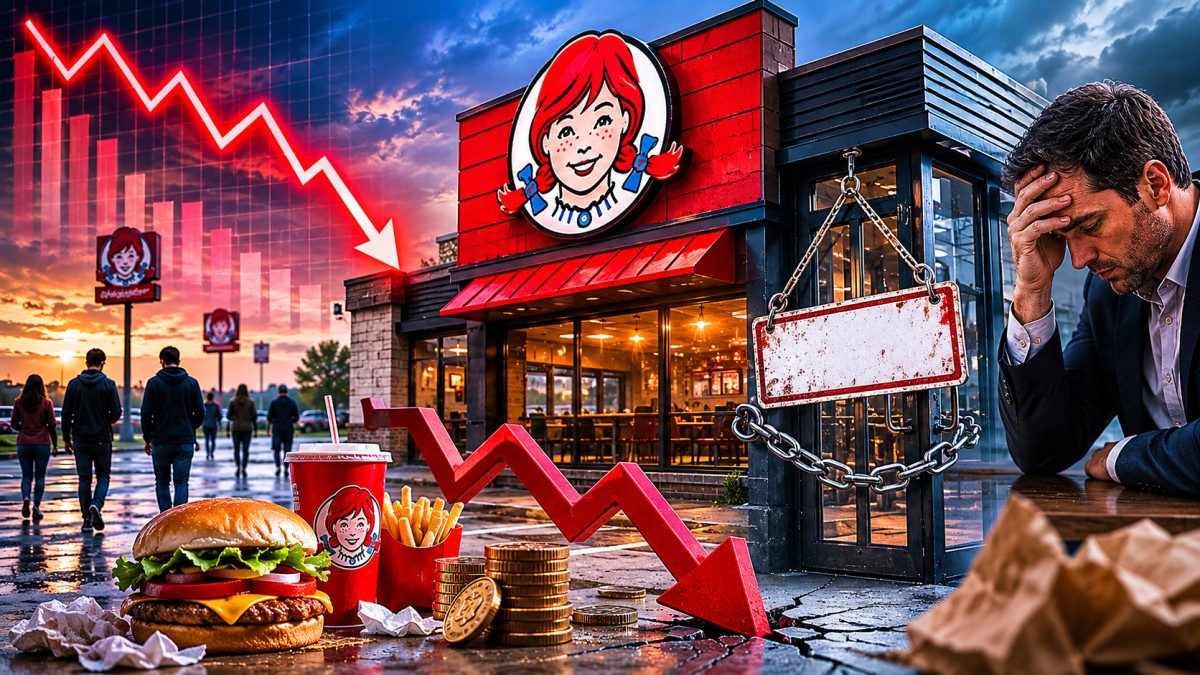
For decades, Wendy’s represented something uniquely American. It was the fast-food brand that tried to stand apart from the crowd with square burgers, fresh beef, witty advertising, and a slightly more premium identity than its competitors. Its famous slogan, “Fresh, Never Frozen,” helped position the chain as a higher-quality alternative in the burger wars.
But in 2026, Wendy’s is no longer viewed as one of the unstoppable giants of American fast food. Instead, the company is facing one of the most difficult periods in its modern history. Falling sales, declining customer trust, restaurant closures, franchisee pressure, rising food costs, and fierce competition have all combined to weaken the brand’s position.
While the company still enjoys strong name recognition and loyal customers, analysts increasingly believe Wendy’s is trapped in a dangerous middle ground — too expensive to dominate value fast food, but not premium enough to win against upscale burger chains.
The decline has not happened overnight. It is the result of years of shifting consumer habits, operational problems, economic pressure, and strategic missteps that slowly eroded Wendy’s once-powerful market identity.
The Rise of Wendy’s as an American Fast-Food Icon
Founded in 1969 by Dave Thomas in Columbus, Ohio, Wendy’s quickly built a reputation for being different from traditional fast-food chains. Unlike competitors that focused heavily on frozen ingredients and mass production, Wendy’s emphasized freshness and quality.
The chain became famous for several signature products and marketing ideas:
Square burger patties
Frosty desserts
Fresh beef burgers
The legendary “Where’s the Beef?” advertising campaign
During the 1980s and 1990s, Wendy’s was deeply embedded in American culture. Families stopped there during road trips, students worked their first jobs there, and millions of customers associated the brand with dependable fast food that felt slightly better than average burger chains.
However, the restaurant industry changed dramatically over the last two decades. Consumer expectations evolved, fast-casual restaurants exploded in popularity, delivery apps transformed dining behavior, and competitors became far more aggressive with pricing and marketing.
Wendy’s struggled to adapt quickly enough.
Falling Sales Have Become a Major Warning Sign
One of the biggest signs of Wendy’s ongoing troubles is its declining sales performance.
The company reported severe same-store sales declines across multiple quarters. According to recent figures, Wendy’s experienced:
An 11.3% decline in U.S. same-store sales during Q4 2025
A 5.6% annual decline in domestic sales
A 3.5% decline in global sales
Even more concerning, the company recorded five consecutive quarters of declining domestic sales — one of its worst performance streaks in nearly two decades.
In the restaurant business, same-store sales are one of the most important indicators of a brand’s health because they measure whether existing restaurants are attracting customers and generating growth. A prolonged decline usually signals weakening customer demand or poor brand perception.
Compared to competitors, Wendy’s numbers look even more troubling.
The average Wendy’s location reportedly generates around $2.1 million in annual sales, while the average McDonald’s restaurant produces nearly $3.96 million annually. That massive gap highlights how much stronger McDonald’s remains operationally and financially.
Customers Believe Wendy’s Has Become Too Expensive
One of the most damaging issues for Wendy’s has been customer frustration over rising prices.
Many consumers now believe the chain no longer delivers strong value for money. Reports indicate Wendy’s menu prices increased roughly 55% since 2014, while overall U.S. inflation during the same period was closer to 31%.
That pricing gap significantly damaged customer trust.
Fast-food customers are extremely sensitive to value. Many consumers visit chains like Wendy’s specifically because they want affordable meals. When prices rise too quickly, customers often switch to cheaper competitors.
That is exactly what appears to be happening.
Budget-conscious customers increasingly moved toward lower-cost options offered by:
McDonald’s
Burger King
Discount meal competitors
Local value-focused chains
At the same time, customers willing to pay premium prices often choose upscale burger brands such as:
Shake Shack
Five Guys
Culver’s
This has left Wendy’s stuck in an uncomfortable position between cheap fast food and premium fast casual dining.
The “Fresh Beef” Strategy Became More Expensive
Wendy’s built its entire identity around fresh beef rather than frozen patties. For years, that strategy helped differentiate the company from competitors.
But in today’s economic environment, that same strategy has become far more expensive.
Fresh beef requires:
Faster supply chain logistics
Advanced refrigeration systems
Higher transportation costs
More complex inventory management
Meanwhile, beef prices reached record highs in recent years, placing enormous pressure on restaurant operators and franchise owners.
As food costs increased, Wendy’s faced a difficult decision:
Raise prices and risk losing customers
Keep prices low and reduce profitability
The company attempted to balance both, but neither customers nor franchisees appeared fully satisfied with the outcome.
Shrinkflation Hurt Customer Confidence
Another issue damaging Wendy’s reputation is “shrinkflation” — reducing portion sizes while increasing or maintaining prices.
Customers increasingly complained about:
Smaller burgers
Smaller chicken nugget portions
Higher prices despite reduced quantities
In the fast-food industry, perception matters enormously. Even if ingredient costs rise, customers react negatively when they believe they are receiving less food for more money.
Social media amplified many of these complaints, further hurting Wendy’s image among younger consumers.
Franchise Owners Are Under Financial Pressure
A major portion of Wendy’s restaurants are operated by franchisees rather than the company itself.
When franchise owners struggle financially, the effects quickly spread across the customer experience.
Analysts say many Wendy’s operators have faced declining profitability due to rising labor costs, expensive ingredients, inflation, and weaker customer traffic. As margins shrink, franchisees often cut operational spending to survive.
That can lead to:
Slower service
Dirty dining rooms
Staffing shortages
Lower food quality
Poor customer experiences
These operational problems directly damage the brand’s reputation.
Unlike premium chains that can justify higher prices with superior service, Wendy’s customers expect both quality and affordability. Delivering both consistently has become increasingly difficult.
Restaurant Closures Reflect Deeper Problems
Perhaps the clearest sign of Wendy’s ongoing struggles is the growing number of restaurant closures.
The company reportedly closed around 200 U.S. restaurants recently, while another 300 locations may be at risk. Wendy’s also plans to reduce approximately 5–6% of its U.S. footprint during 2026.
Restaurant closures are usually more than just a cost-cutting measure. They often indicate deeper structural issues such as:
Weak profitability
Poor traffic
Franchise distress
Oversaturation
Changing consumer behavior
Closing underperforming stores may help improve short-term financial results, but it can also weaken brand visibility and customer accessibility over time.
Leadership Challenges Added More Uncertainty
Leadership instability has also contributed to Wendy’s difficult position.
Kirk Tanner became CEO in 2024 after previously working at PepsiCo. During his leadership, the company faced criticism over discussions surrounding dynamic pricing — a strategy many consumers interpreted as “surge pricing” for burgers.
The backlash created negative publicity and damaged consumer trust further. Many customers feared fast-food prices could fluctuate similarly to airline tickets or ride-sharing apps.
In May 2026, Wendy’s appointed Robert D. Wright as its new CEO. Wright previously held leadership roles at companies including Domino’s and Potbelly.
Industry observers believe Wright may have the operational experience needed to stabilize the business, but turning around a struggling fast-food brand is rarely quick or easy.
Wendy’s Stock Has Lost Significant Value
Investors have also lost confidence in the company.
Wendy’s stock reportedly declined from more than $16 per share in early 2025 to nearly $8 per share by early 2026, wiping out more than half of its value over five years.
Declining stock prices often reflect broader concerns about:
Long-term growth
Competitive positioning
Profitability
Leadership strategy
Future expansion potential
For publicly traded restaurant companies, weak investor confidence can make large-scale turnarounds even harder because financial flexibility becomes more limited.
Competition Is More Intense Than Ever
The fast-food burger industry has become brutally competitive.
Wendy’s is now fighting for customers against multiple types of rivals simultaneously:
Traditional Fast-Food Giants
McDonald’s
Burger King
Premium Fast-Casual Chains
Shake Shack
Five Guys
Culver’s
Delivery-Focused Local Restaurants
Regional burger chains
Independent restaurants on food delivery apps
Among these competitors, Culver’s has emerged as a particularly strong threat because of its reputation for:
Clean restaurants
Friendly service
Fresh ingredients
Strong customer satisfaction
Wendy’s once differentiated itself through freshness and quality, but competitors have increasingly improved in those same areas.
Wendy’s Breakfast Expansion Failed to Deliver
Wendy’s attempted to expand aggressively into breakfast beginning in 2020.
The strategy initially generated excitement because breakfast is one of the most profitable segments in fast food. However, the COVID-19 pandemic disrupted the rollout, supply chains became unstable, and consumer routines changed dramatically.
Now, several franchise owners are reportedly scaling back breakfast operations, suggesting the expansion failed to meet expectations.
That matters because breakfast was supposed to become a major long-term growth engine for the company.
International Growth Offers Some Hope
Despite domestic struggles, Wendy’s international business has shown stronger momentum.
The company reportedly operates in more than 30 countries, while international sales increased approximately 8.1%. Wendy’s also plans to open around 1,000 restaurants in China over the next decade.
International expansion could eventually become an important growth driver, especially if U.S. operations continue weakening.
However, the American market remains Wendy’s primary financial foundation. Without stabilizing its domestic business, international growth alone may not be enough to fully revive the company.
Can Wendy’s Recover?
Wendy’s is not collapsing overnight. The brand still possesses enormous strengths:
Strong name recognition
Loyal customers
Established franchise network
International expansion opportunities
Deep cultural familiarity in America
The company has also launched turnaround efforts including:
“Project Fresh” operational restructuring
New marketing strategies
Value-focused “Biggie” meal deals
Cost optimization plans
Early signs suggest some stabilization may be happening, with sales declines improving slightly after new value promotions were introduced.
Still, recovery will likely take years rather than months.
Wendy’s biggest challenge is rebuilding consumer trust while simultaneously improving profitability for franchise owners. That balancing act is extremely difficult in today’s fast-food environment, where customers demand better quality, faster service, and lower prices all at once.
Conclusion
The struggles facing Wendy’s in 2026 are not caused by a single mistake. Instead, they reflect a combination of economic pressure, strategic challenges, rising costs, operational weaknesses, and changing consumer expectations.
The chain that once stood proudly as America’s fresh-burger alternative is now fighting to redefine its identity in an industry that has become more competitive than ever.
Wendy’s still remains one of the most recognizable fast-food brands in the world, but recognition alone is no longer enough. To recover, the company must prove it can deliver strong value, maintain quality, improve restaurant operations, and reconnect with customers who increasingly have endless dining choices.
Whether Wendy’s can successfully reinvent itself over the next few years may determine whether the iconic burger chain experiences a lasting comeback — or continues its slow decline in the rapidly changing fast-food industry.
Disclaimer
This article is based on publicly available industry reports, market analysis, company updates, and user-provided research material. Financial figures, projections, and operational estimates may change over time as new company data becomes available.
Source
User-provided research document and industry analysis.