Major Marvel Movie Twists That Changed Superhero Cinema
For decades, superhero movies followed a familiar formula. Heroes protected their identities, villains were usually straightforward, and audiences often knew exactly how stories would end. But Marvel changed that formula completely. Over the years, Marvel films have delivered shocking twists, emotional betrayals, and unforgettable reveals that transformed comic book movies into some of the most talked-about stories in modern cinema.
Some of these moments surprised audiences because they broke long-standing superhero traditions. Others worked because they added emotional depth to characters fans already loved. Whether it was a heartbreaking death, a hidden family connection, or a public identity reveal, these twists became defining moments for Marvel storytelling.
Here are some of the biggest Marvel movie twists and reveals that left audiences stunned and helped redefine the superhero genre.
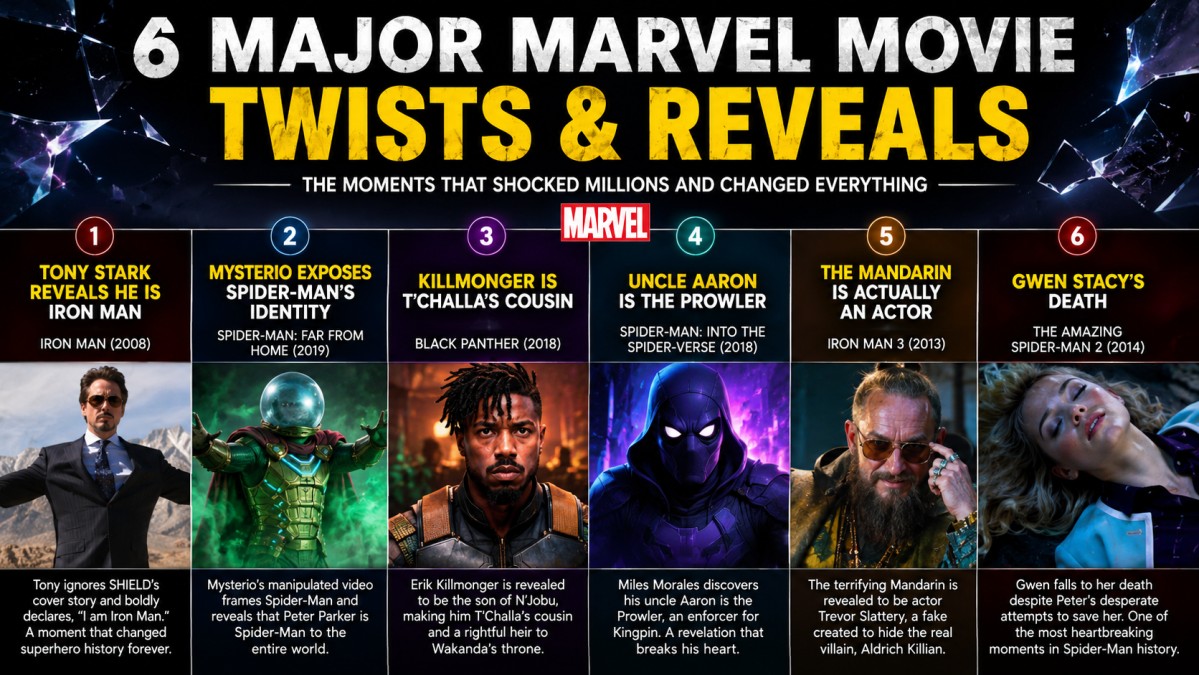
Tony Stark Reveals He Is Iron Man
Movie: Iron Man
When the first MCU film arrived in 2008, audiences expected a fairly traditional superhero origin story. Most comic book heroes had one thing in common: they protected their secret identities at all costs. Characters like Spider-Man, Batman, and Superman understood that keeping their identities hidden protected both themselves and the people they loved.
Tony Stark changed everything.
At the end of the movie, SHIELD prepares a carefully designed cover story to explain the appearance of Iron Man. The expectation is simple: Stark will deny being the armored hero. Instead, during a press conference, Tony casually looks at the reporters and says the now-iconic line:
“I am Iron Man.”
The moment instantly shocked audiences because it completely rejected the classic superhero formula. Tony Stark was not interested in secrecy. His ego, confidence, and personality made him fundamentally different from the heroes audiences were used to seeing.
More importantly, this twist changed the direction of the entire Marvel Cinematic Universe. Instead of hiding behind masks, MCU heroes often faced public scrutiny, political consequences, and media attention. Tony’s reveal made superheroes feel more grounded in reality because fame became part of the story itself.
The ending also perfectly captured Tony Stark’s personality. He was brilliant, reckless, arrogant, and impossible to control. No government agency or organization could force him to stay silent.
Years later, that press conference still stands as one of the most iconic endings in superhero movie history. It did not just launch a franchise — it changed how superhero stories could be told.
Mysterio Exposes Spider-Man’s Identity
Movie: Spider-Man: Far From Home
Spider-Man has always been defined by the importance of secrecy. Peter Parker’s dual life creates constant tension because his personal relationships become endangered if people discover who he really is.
That is why the ending of Far From Home became such a massive shock.
Throughout the movie, Peter Parker struggles with the pressure of becoming the next major hero after Tony Stark’s death. During this vulnerable period, Quentin Beck — also known as Mysterio — manipulates Peter by pretending to be a trustworthy superhero from another universe.
Eventually, Peter discovers the truth. Mysterio is not a hero at all. He is a master illusionist using advanced technology to create fake monster attacks in order to gain fame and recognition.
Even after his apparent defeat, Mysterio still manages to win one final battle.
In the film’s final moments, a manipulated video is released to the public. The footage falsely frames Spider-Man for the destruction and chaos caused by Mysterio. Then comes the real shock: the broadcast publicly reveals that Spider-Man is actually Peter Parker.
The scene becomes even more memorable with the return of J. Jonah Jameson, one of Spider-Man’s most famous comic book characters.
For Peter, the reveal destroys any remaining separation between his normal life and his superhero responsibilities. Suddenly, the entire world knows who he is. His family, friends, and future all become vulnerable overnight.
The twist completely changed the direction of Spider-Man’s MCU story and directly led into the events of No Way Home. More importantly, it modernized the classic secret identity problem for the social media era, where misinformation and viral media can instantly destroy someone’s life.
Killmonger Is T’Challa’s Cousin
Movie: Black Panther
One of the reasons Black Panther became such a powerful film was its emotional complexity. Instead of presenting a simple villain-versus-hero conflict, the movie explored themes of history, responsibility, isolation, and injustice.
That complexity reached another level with the reveal surrounding Erik Killmonger.
Initially introduced as a dangerous outsider seeking Wakanda’s throne, Killmonger eventually learns — and reveals — that he is actually the son of Prince N’Jobu. This means he is T’Challa’s cousin and a rightful member of Wakanda’s royal bloodline.
The twist instantly changes the emotional dynamics of the story.
Killmonger is no longer simply an enemy trying to seize power. He is someone abandoned by his own family and left behind by a nation that chose isolation over helping oppressed people around the world. His anger comes from personal pain, betrayal, and years of suffering.
The reveal forces T’Challa to confront uncomfortable truths about Wakanda’s history and the failures of previous generations. It also challenges the audience to understand Killmonger rather than simply hate him.
That emotional depth helped make Killmonger one of Marvel’s greatest villains. Unlike many comic book antagonists, his motivations felt human and understandable. Audiences could disagree with his methods while still sympathizing with his pain.
The twist transformed Black Panther from a traditional superhero film into a deeply emotional family tragedy with political and cultural significance.
Uncle Aaron Is the Prowler
Movie: Spider-Man: Into the Spider-Verse
Animated superhero films are often expected to be lighter and simpler than live-action stories. Into the Spider-Verse completely rejected that assumption by delivering one of the most emotional reveals in Spider-Man history.
Miles Morales deeply admires his Uncle Aaron. Compared to Miles’ strict and demanding father, Aaron feels relaxed, understanding, and supportive. Their bond becomes one of the emotional foundations of the film.
That is why the reveal hits so hard.
Miles eventually discovers that Aaron is secretly the Prowler, a dangerous criminal working for Kingpin. Worse still, Aaron’s actions directly place Miles in danger.
The emotional impact of the twist comes from betrayal rather than spectacle. Miles trusted Aaron completely, making the discovery devastating. For the first time, Miles realizes that the people he loves are not perfect and that adulthood can involve painful truths.
The reveal also strengthens Miles’ journey into becoming Spider-Man. Heroism suddenly becomes personal. Miles must learn how to make difficult moral choices even when emotions are involved.
The relationship between Miles and Aaron adds remarkable emotional maturity to the film. Instead of presenting a simple good-versus-evil conflict, Spider-Verse explores family loyalty, regret, and personal responsibility.
That emotional honesty helped make the movie one of the greatest animated superhero films ever created.
The Mandarin Is Actually an Actor
Movie: Iron Man 3
Few Marvel twists divided audiences as much as the Mandarin reveal in Iron Man 3.
Throughout the film, the Mandarin is presented as a terrifying international terrorist mastermind responsible for bombings and political chaos. His threatening speeches and mysterious appearance create the impression that Tony Stark is finally facing his most dangerous enemy yet.
Then Marvel completely flips expectations.
Tony eventually discovers that the feared Mandarin is actually Trevor Slattery, a confused and goofy actor hired to play the role. The real mastermind behind the attacks is Aldrich Killian, who created the fake terrorist persona to hide his own operations.
The twist shocked audiences because the Mandarin is one of Iron Man’s most famous comic book villains. Many fans expected a more traditional adaptation of the character and felt frustrated by the comedic reveal.
At the same time, others praised the twist for being bold and unpredictable. Instead of delivering another standard villain story, Iron Man 3 explored themes of media manipulation, fear, propaganda, and manufactured terrorism.
Trevor Slattery himself eventually became a surprisingly memorable MCU character and later returned in future Marvel projects.
Whether fans loved or hated the reveal, there is no denying that it became one of the most talked-about twists in Marvel history.
Gwen Stacy’s Death
Movie: The Amazing Spider-Man 2
Some twists shock audiences because they are surprising. Others devastate audiences emotionally.
Gwen Stacy’s death did both.
Peter Parker and Gwen Stacy were portrayed as one of the strongest and most believable romantic couples in superhero cinema. Their chemistry felt natural, emotional, and deeply genuine. Many viewers expected Gwen to remain a major part of Peter’s future.
Instead, the film delivered one of the most tragic scenes in Spider-Man history.
During the final battle, Gwen falls from a massive height after being attacked by the Green Goblin. Peter desperately tries to save her using his web. For a brief moment, it appears he might succeed.
But he is too late.
The scene becomes even more heartbreaking because Peter nearly saves her. That tiny delay changes everything.
Gwen’s death has always been one of the defining tragedies in Spider-Man comics, and the film adaptation captured the emotional weight of that moment perfectly. Peter is forced to confront the painful reality that being Spider-Man comes with devastating consequences.
The loss permanently changes him as a character. It teaches him that even heroes cannot save everyone.
Years later, the scene remains one of the most emotional moments ever shown in a Marvel-related film.
Why These Marvel Twists Still Matter
What makes these reveals so memorable is not just shock value. The best Marvel twists work because they permanently change characters, relationships, and entire storylines.
Tony Stark’s reveal changed superhero identities forever. Mysterio’s manipulation destroyed Peter Parker’s privacy. Killmonger’s family connection added emotional complexity to Black Panther. Uncle Aaron’s secret identity shattered Miles Morales’ trust. The Mandarin twist challenged audience expectations. Gwen Stacy’s death reminded viewers that superhero stories can carry real tragedy.
Together, these moments helped Marvel evolve beyond simple action entertainment. They proved superhero movies could include emotional depth, moral complexity, and genuine unpredictability.
That is why audiences continue talking about these twists years after the films were released. They were not just shocking scenes — they were turning points that shaped the future of superhero storytelling.
Disclaimer
This article is written for entertainment and informational purposes only. All characters, movies, names, and related elements mentioned belong to their respective creators, studios, and copyright holders, including Marvel Studios and associated production companies. No copyright infringement is intended.


One thought on “Major Marvel Movie Twists That Changed Superhero Cinema”