The Boy From Madeira
There is a small, volcanic island off the coast of Portugal called Madeira. It is known for its wine, its flowers, and its cliffs that fall sharply into the Atlantic. It is not, historically, a place the football world has paid much attention to. But on the 5th of February, 1985, a boy was born in Funchal — the island’s capital — who would go on to change that forever.
Cristiano Ronaldo dos Santos Aveiro was the youngest of four children born to José Dinis Aveiro and Maria Dolores. His father, a kit man at local club Andorinha, named him partly after his favourite actor — U.S. President Ronald Reagan, who was also an actor before his time in the White House. It is one of the more unusual origin stories in football, but then Ronaldo’s entire life has been one of unusual chapters.
Growing up in a modest household, young Cristiano was obsessed with football from the moment he could walk. He joined Andorinha at the age of seven, moved to Nacional at ten, and by twelve had caught the eye of Sporting CP’s scouts in Lisbon. Leaving his family on the island at that young age was difficult — he wept, homesick and isolated in a new city — but the sacrifice was the first of many he would make in pursuit of greatness.
At Sporting’s academy, he was sometimes teased for his Madeiran accent. Rather than breaking him, it hardened him. He trained longer, ran faster, and worked until nobody could ignore him. At fifteen, he was diagnosed with tachycardia — a heart condition that required laser surgery. Doctors cleared him quickly. He never looked back.
A Teenager Who Turned Heads at Old Trafford
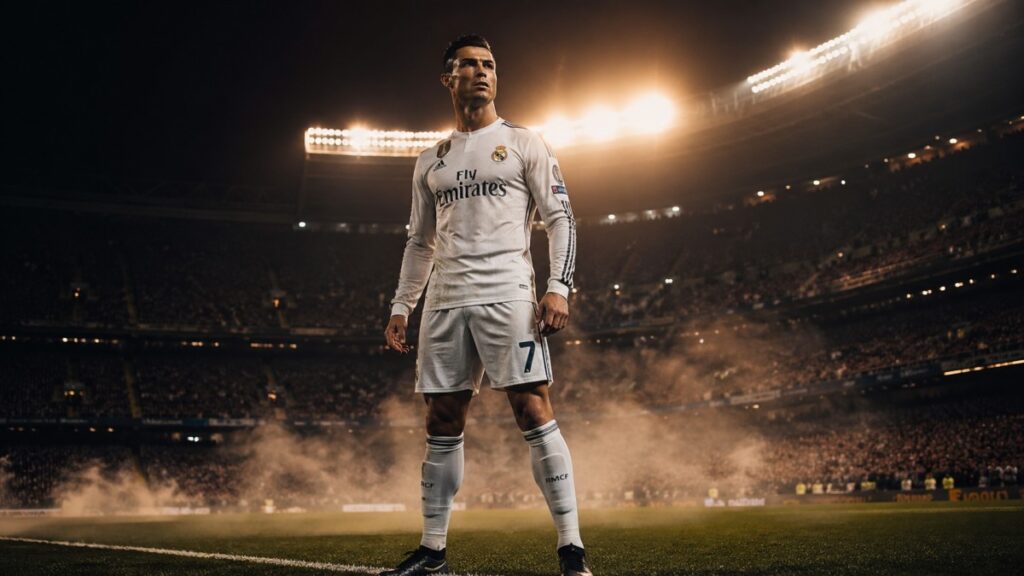
In 2002, Ronaldo broke into Sporting CP’s first team. He was seventeen. During a pre-season friendly against Manchester United in August 2003, he put on a performance so electrifying that United’s players reportedly lobbied Sir Alex Ferguson to sign him before the game was even over. Ferguson obliged, paying £12 million — a record fee for a teenager in England at the time.
He arrived at Old Trafford as a boy — impossibly skilful, maddening to defend against, but raw and inconsistent. The step-overs were dazzling, the showboating sometimes excessive. United supporters loved him. Defenders loathed him. Ferguson mentored him with patience and steel in equal measure.
The transformation was gradual, then sudden. By the 2006–07 season, he was scoring 17 Premier League goals. The following season — 2007–08 — he exploded with 31 league goals, winning the Premier League Golden Boot and, alongside Wayne Rooney, driving United to the Champions League title. That night in Moscow, when United beat Chelsea on penalties, Ronaldo had tears in his eyes when he missed his spot-kick. United still won. He was named FIFA World Player of the Year. He was 23 years old.
The Ballon d’Or followed. His first of five.
The Real Madrid Years — History Rewritten
In the summer of 2009, Real Madrid broke the world transfer record, paying Manchester United £80 million for their prized asset. It was a number that made headlines around the world. What followed over the next nine years made those headlines look modest.
At the Bernabéu, Ronaldo did not just excel — he reinvented what a footballer could achieve statistically. In his debut season he scored 33 goals across all competitions. The following year he became the first player in history to score 40 La Liga goals in a single season. By 2011–12, he had set a record that still staggers — 60 goals in all competitions in one calendar year.
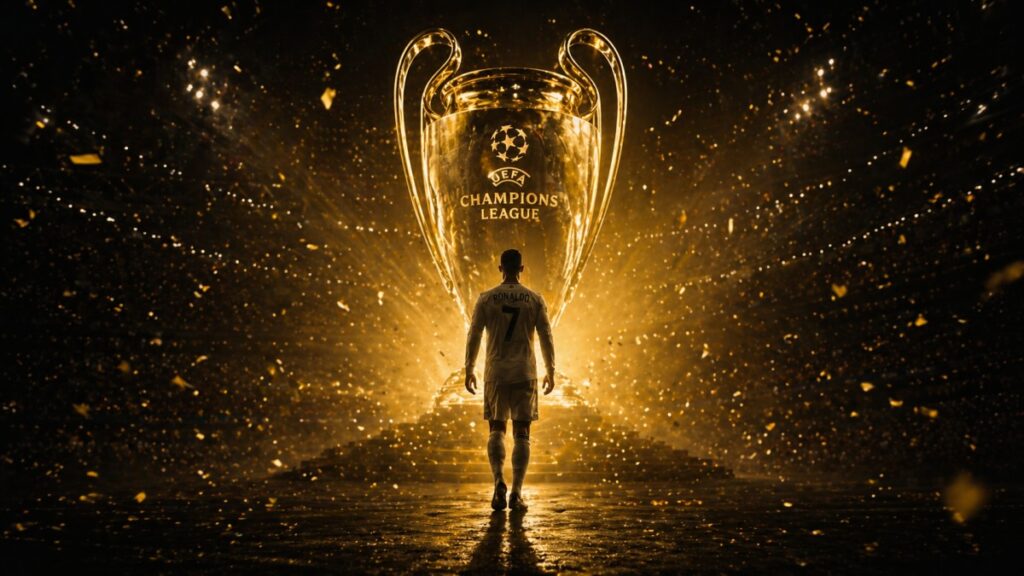
Season after season, the numbers piled up. In 2013–14, he scored a then-record 17 Champions League goals as Real Madrid won “La Décima” — their tenth European Cup, ending a twelve-year wait. The following season, he scored 61 goals — a personal best. He won the Ballon d’Or again in 2013, 2014, 2016, and 2017.
He scored his 400th Real Madrid goal. Then his 450th. He became the all-time top scorer in Champions League history — a record he holds to this day with 140 goals, a figure that seems almost impossible to contemplate. In nine seasons at the club, he scored 311 goals in La Liga and 450 goals across all competitions, winning four Champions League titles, two La Liga titles, and countless individual honours.
When he left Real Madrid in 2018, it was not with a whimper. It was after completing a Champions League hat-trick against Juventus that had the opposing fans rising to applaud him. He was 33 years old. He still had things to prove.
Italy, Turin, and the Quest for New Mountains
Juventus paid €100 million for him — a world record for a player over thirty. Eyebrows were raised. Some suggested the era was ending. Ronaldo responded by winning two Serie A titles and, in 2020–21, becoming the league’s top scorer — the Capocannoniere — at the age of 36.
He had now scored 100 or more goals in three different leagues. He had won league titles in England, Spain, and Italy. He was not just a generational talent — he was something football had never quite seen before.
The Portugal Legacy — A Nation’s Greatest Son
It is sometimes forgotten, amid all the club glory, that Ronaldo’s international career stands entirely in a category of its own. He made his debut for Portugal on 20 August 2003, the same year he arrived at Manchester United. He scored his first international goal at Euro 2004.
Twenty-two years later, he is the most capped male player in the history of international football with 226 appearances, and the all-time leading scorer in men’s international football with 143 goals — a record that seems almost untouchable. He has captained his country since Euro 2008. He has played in five World Cups and six European Championships. At the 2018 World Cup, he scored a hat-trick against Spain in one of the great individual performances in tournament history.
The trophy he wanted most arrived in 2016, when Portugal defeated France in the final of the European Championship on home soil — in Paris — despite Ronaldo himself going off injured in the first half. He spent the rest of the match on the touchline, his knee heavily strapped, coaching and urging his teammates. When the final whistle blew, he collapsed in tears. It was, perhaps, his most human moment.
Portugal won the UEFA Nations League in 2019 and again in 2025. He has now won every major honour the international game can offer.
Al-Nassr, Saudi Arabia, and the Final Chapter
In January 2023, following a messy departure from Manchester United — where he had scored 27 goals in a difficult second spell — Ronaldo signed for Al-Nassr in Saudi Arabia. The move was met with scepticism in Europe. Many believed it was a retirement move, a final payday, a slow exit from the stage.
What followed was typical Ronaldo. He dominated the Saudi Pro League with a ferocity that silenced critics. In 2023–24, he scored 35 league goals — a record for a single season in the Saudi Pro League. The following season, 2024–25, he won the Golden Boot again. At 40 years old, he remains the league’s most dangerous striker and, by a considerable distance, its biggest star.
His salary at Al-Nassr — €200 million per year including commercial deals — makes him the highest-paid athlete on earth, a title Forbes has given him five times in his career. He was the world’s highest-paid athlete in 2023, 2024, and 2025, three consecutive years. His total career earnings stand at approximately $2.52 billion, making him the first footballer and one of very few athletes to earn $1 billion from the sport.
The Man Behind the Machine
Away from the football, Ronaldo is a complex, deeply driven human being. He speaks openly about his father José, who died in 2005 from liver failure at just 52 — a loss that visibly shaped him. His mother Maria Dolores has been a constant presence throughout his career, surviving breast cancer and remaining the emotional anchor of the family.
He has five children: his son Cristiano Jr., born in 2010, who now plays for Portugal’s Under-15 national team; twins born in 2017; a daughter born later that year; and twins born in 2022, one of whom tragically did not survive. He is engaged to Georgina Rodríguez, an Argentine-Spanish model with whom he has been since 2016, with the engagement confirmed in August 2025.
His hometown of Funchal renamed its airport in his honour in 2016. There is a museum dedicated to him there — Museu CR7 — opened in 2013. A galaxy was named after him in 2015. Sporting CP renamed their academy the Academia Cristiano Ronaldo. In February 2026, he acquired a 25% ownership stake in Spanish club UD Almería. He co-owns a media company in Portugal. He runs a fashion brand. He launched a YouTube channel in August 2024.
He has over one billion combined social media followers — the first human being in history to reach that number across platforms.
What Makes Him Different
The debate about whether Ronaldo or Lionel Messi is the greatest player of all time will likely never have a consensus answer, and that is part of what makes it fascinating. But what is undeniable about Ronaldo — and what makes him a singular figure beyond the debate — is the nature of his greatness.
He was not born with Messi’s otherworldly natural touch. He was not the most gifted youth player at Sporting’s academy. What he had — and what has never diminished with age — is an almost pathological refusal to accept limitation. He reinvented his game multiple times: from electric winger to goalscoring machine to free-roaming centre forward. He changed his physique, his diet, his sleeping patterns. He reportedly sleeps in multiple short cycles rather than one long sleep. He practises free kicks in the dark to sharpen his muscle memory.
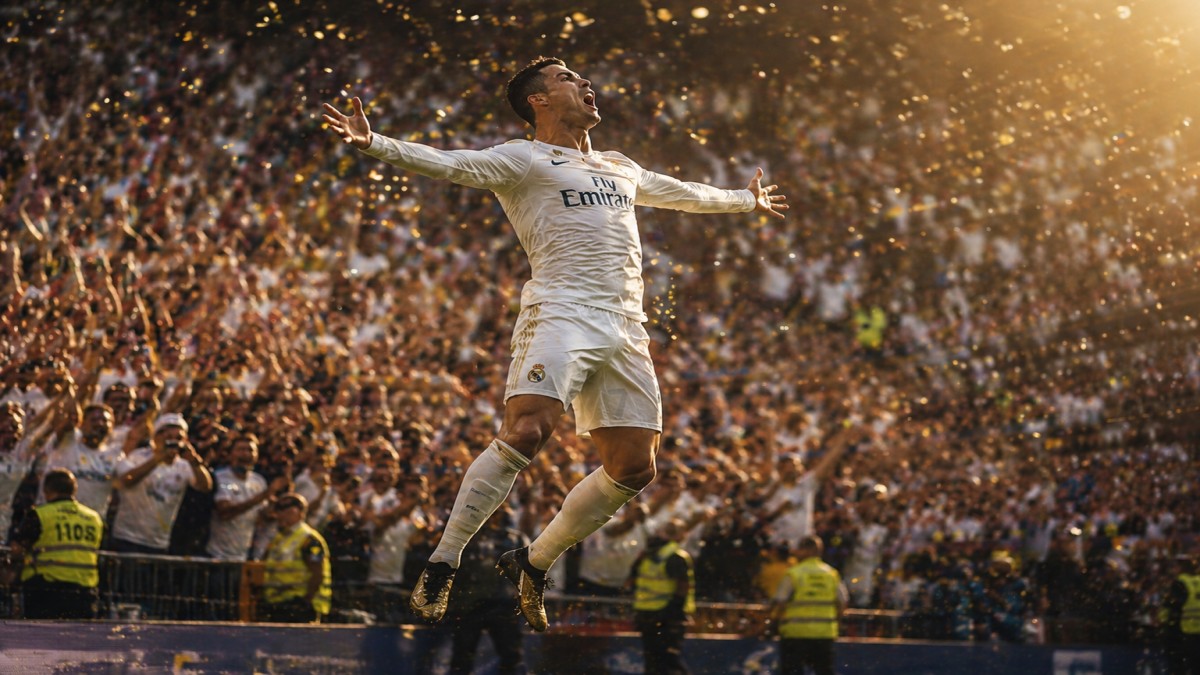
His trademark “Siuuu” celebration — the jump, the spin, the pose — was first performed on 7 August 2013. In the years since, it has become one of the most recognisable gestures in world sport.
The Numbers Don’t Lie
At the time of writing, Cristiano Ronaldo has scored over 960 official career goals across clubs and country — the highest total in the history of the sport. He holds the record for most Champions League goals (140), most Champions League assists (42), most goals at European Championships (14), most World Cup qualifying goals for a European nation (41), and most international caps for any male player (226).
He is 41 years old. He is still playing. He is still scoring.
Whatever one thinks about his personality, his theatrics, his social media presence, or the noise that follows him everywhere — the football record is simply unmatched. A boy from a small Atlantic island who refused, at every stage, to be told what was possible.
That, in the end, is the Cristiano Ronaldo story. It is not finished yet.
Disclaimer: This profile is created for informational and editorial purposes only. All statistics, records, and personal details are based on publicly available data and may not reflect the most current figures. This content is not affiliated with, endorsed by, or officially connected to Cristiano Ronaldo, his management, or any associated organizations. All trademarks, names, and images referenced belong to their respective owners.
Question-1: Who is Cristiano Ronaldo Jr?
Cristiano Ronaldo Jr. is the eldest son of Cristiano Ronaldo. He is a young football talent and has trained in youth academies of top clubs like Juventus and Manchester United.
Question-2: How many goals has Cristiano Ronaldo scored in his career?
Cristiano Ronaldo has scored over 850+ official career goals for club and country, making him one of the greatest goal scorers in football history.
Question-3: What is Cristiano Ronaldo’s Instagram account?
Cristiano Ronaldo’s official Instagram handle is @cristiano, where he shares updates about football, fitness, lifestyle, and endorsements.
Question-4: Where can I read about Cristiano Ronaldo on Wikipedia?
You can find complete details about his career, records, awards, and personal life on his official Wikipedia page.
Question-5: How many children does Cristiano Ronaldo have?
Cristiano Ronaldo has five children: Cristiano Ronaldo Jr., twins Eva and Mateo, Alana Martina, and Bella Esmeralda.
Question-6: What is Cristiano Ronaldo’s net worth?
Cristiano Ronaldo’s estimated net worth is over $500 million, earned through football contracts, sponsorships, and business ventures.
Question-7: Who is Cristiano Ronaldo’s wife?
Cristiano Ronaldo is not officially married, but he is in a long-term relationship with Georgina Rodríguez.
Question-8: What is Transfermarkt data for Cristiano Ronaldo?
Transfermarkt provides detailed statistics including market value, transfer history, appearances, and performance data throughout Cristiano Ronaldo’s career.


2 thoughts on “Cristiano Ronaldo: The Man Who Refused to Be Ordinary”