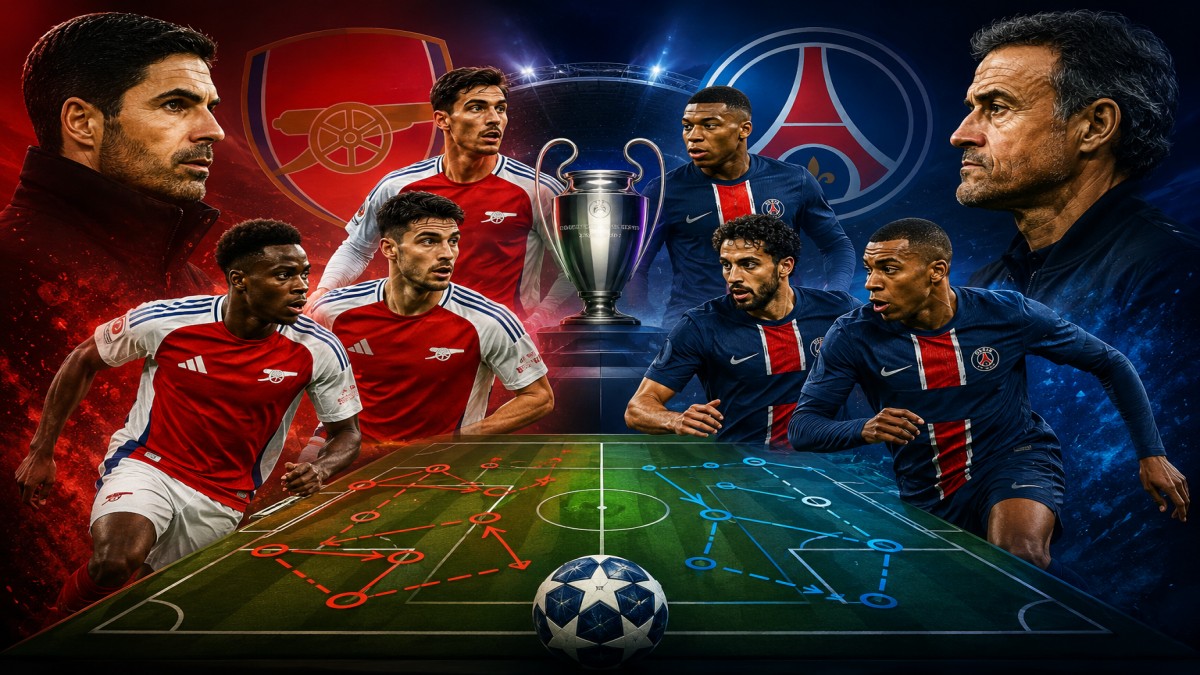
Arsenal vs PSG Champions League Final: Tactical Battles That Could Shape European Glory
The UEFA Champions League final promises a fascinating clash of football philosophies as Arsenal prepare to face Paris Saint-Germain in one of the most anticipated matches of the season. Mikel Arteta’s side arrives with the competition’s strongest defensive record, while Luis Enrique’s PSG have established themselves as Europe’s most devastating attacking force.
The final presents a classic battle between defensive discipline and attacking creativity. Arsenal have built their European campaign on structure, control, and possession, whereas PSG have overwhelmed opponents with relentless pressing, fluid movement, and an impressive goal-scoring record.
With both clubs chasing continental glory, several tactical battles could ultimately determine who lifts the Champions League trophy.
Arsenal’s Defensive Excellence Faces Its Toughest Test
Arsenal’s journey to the final has been defined by defensive consistency. The Gunners have recorded nine clean sheets in the competition, more than any other team, showcasing the effectiveness of Arteta’s carefully constructed defensive system.
Unlike many elite teams that rely purely on defensive organization, Arsenal defend through possession. Their ability to dominate the ball reduces the number of opportunities opponents can create. By controlling territory and spending long periods in the opposition half, Arsenal have successfully limited dangerous transitions throughout the tournament.
However, PSG represent a different level of attacking challenge.
The French champions have scored 44 goals in the Champions League this season, making them the tournament’s most prolific attacking side. Their ability to create chances from multiple areas of the pitch means Arsenal’s defense will face pressure unlike anything encountered earlier in the competition.
The battle between Arsenal’s defensive structure and PSG’s attacking quality could become the defining storyline of the final.
Why Mikel Merino’s False Nine Role Could Be Crucial
One of Arsenal’s most interesting tactical options involves Mikel Merino operating as a false nine.
The Spanish midfielder has previously demonstrated his effectiveness in advanced positions, particularly against teams that employ aggressive pressing systems. Rather than remaining high up the pitch like a traditional striker, Merino often drops into midfield to create numerical superiority in central areas.
This movement creates a difficult dilemma for opposing defenders.
If PSG’s center-backs follow him into midfield, space opens behind the defensive line. If they remain in position, Arsenal gain an extra player during build-up phases, helping them bypass PSG’s intense pressure.
The strategy could be particularly valuable against Luis Enrique’s man-oriented pressing system. By creating overloads in midfield, Arsenal may find more opportunities to progress the ball through central areas and maintain possession under pressure.
Kai Havertz offers similar qualities and could perform the role equally effectively. Both players possess the technical intelligence and positional awareness required to disrupt PSG’s defensive organization.
Direct Play May Offer Arsenal an Alternative Route
Although Arsenal typically prefer a possession-based approach, the final may require greater tactical flexibility.
PSG’s aggressive pressing often forces opponents into mistakes near their own penalty area. One effective solution is to bypass the press entirely through direct passing.
Long balls toward players such as Merino or Havertz can immediately eliminate multiple PSG defenders from the play. Both players excel in aerial duels and have the ability to flick passes into dangerous areas for teammates attacking second balls.
This approach could prove particularly effective during periods when PSG dominate possession or intensify their pressing.
Arsenal’s summer signing Viktor Gyokeres could provide another dimension if involved. Unlike Merino or Havertz, Gyokeres thrives by attacking channels and exploiting spaces behind defensive lines. Direct passes into wide areas would allow him to use his pace and physicality to stretch PSG’s defense.
The ability to alternate between controlled possession and direct attacks could give Arsenal an important tactical advantage.
Exploiting PSG Through Central Areas
Several teams have found success against PSG by attacking through the middle rather than relying solely on wide play.
Opponents such as Chelsea, Bayern Munich, and Lens have demonstrated that PSG’s aggressive man-marking can create exploitable spaces when players position themselves closely together.
By attracting multiple defenders into congested central zones, attacking teams can then use quick combinations to release teammates into open spaces elsewhere on the pitch.
Traditionally, Arsenal generate many of their chances from wide areas through crosses and overlapping full-backs. However, the final may require greater emphasis on central combinations and intricate passing sequences.
Players such as Leandro Trossard, Kai Havertz, Bukayo Saka, Martin Zubimendi, and Eberechi Eze possess the technical quality needed to operate effectively in tight spaces.
Their ability to receive under pressure and quickly combine with teammates could become a vital weapon against PSG’s defensive structure.
The Kvaratskhelia Factor
Among PSG’s many attacking stars, Khvicha Kvaratskhelia stands out as one of the most dangerous.
The Georgian winger has developed a reputation as one of Europe’s most unpredictable attacking players. His movement is exceptionally difficult to track because he constantly alters his positioning, timing, and direction of runs.
Kvaratskhelia’s threat extends beyond his dribbling ability. He excels at creating confusion through off-ball movement, often dragging defenders out of position before exploiting the resulting gaps.
For Arsenal’s backline, concentration will be essential.
Any lapse in defensive communication could allow Kvaratskhelia to create decisive moments in dangerous areas. Arsenal’s defenders must remain disciplined and avoid being drawn into uncomfortable positions by his deceptive movement patterns.
Containing him for the full ninety minutes will be one of the biggest challenges facing Arteta’s team.
Arsenal’s Defensive Strategy Against PSG’s Fluid Attack
PSG’s attack is built around positional fluidity.
While the team consistently occupies key zones—including both wings, central attacking areas, and deeper build-up positions—the players themselves frequently rotate responsibilities.
This constant movement makes traditional marking strategies difficult to execute.
Arsenal therefore face a critical tactical decision.
One option is to press aggressively and tightly mark PSG players whenever they receive possession. This approach could disrupt PSG’s rhythm and prevent them from establishing sustained attacks.
Alternatively, Arsenal could adopt a deeper defensive block designed to limit the space available behind the defense.
Arteta has already demonstrated his willingness to adjust his pressing structure against PSG in previous encounters. Tactical modifications involving Martin Odegaard’s pressing responsibilities and William Saliba’s individual defensive assignments helped Arsenal compete effectively against the French side.
Former Chelsea manager Enzo Maresca has also highlighted the importance of proactive defending against PSG, arguing that allowing them time and space on the ball significantly increases their threat level.
The final may ultimately depend on which defensive approach Arsenal choose.
Set Pieces Could Become the Difference-Maker
While PSG’s attacking quality attracts most of the attention, their vulnerability at set pieces could provide Arsenal with a significant opportunity.
The French champions have conceded multiple goals from corners and free-kicks throughout the season. Their relative lack of physical presence compared to other elite European sides has occasionally been exposed during dead-ball situations.
One recurring weakness has involved defending deliveries toward the back post.
PSG have struggled when opponents float crosses beyond the main defensive line before directing headers back across goal. This pattern has repeatedly created dangerous situations inside the penalty area.
Fortunately for Arsenal, set pieces are one of their greatest strengths.
Under Arteta, the Gunners have become one of Europe’s most effective teams from corners and indirect free-kicks. Their detailed routines, aerial power, and coordinated movement have produced numerous goals over recent seasons.
In a final where open-play opportunities may be limited, a single set-piece situation could prove decisive.
The Key Battles That Could Decide the Trophy
Several tactical themes are likely to shape the outcome of the Champions League final:
- Arsenal’s ability to play through PSG’s aggressive press.
- The effectiveness of Merino or Havertz operating as a false nine.
- Success in creating central overloads and exploiting PSG’s man-marking.
- Arsenal’s capacity to contain Kvaratskhelia and PSG’s fluid attackers.
- The intensity and coordination of Arsenal’s pressing structure.
- Capitalizing on PSG’s defensive weaknesses during set pieces.
- Managing moments of individual brilliance from PSG’s star forwards.
The Champions League final presents one of the most compelling tactical contests in recent memory.
Arsenal enter the match with Europe’s most reliable defense and a clear tactical identity built around possession, structure, and intelligent pressing. PSG arrive as the competition’s most explosive attacking force, capable of producing moments of brilliance from virtually any area of the pitch.
Arteta’s side possess several tactical solutions that could trouble PSG, from midfield overloads created by a false nine to the threat posed by set pieces and direct attacks.
If Arsenal can successfully navigate PSG’s press, exploit weaknesses in defensive transitions, and maintain discipline against their fluid attack, they have every reason to believe they can lift the Champions League trophy.
The stage is set for a fascinating encounter where tactical execution may prove just as important as individual talent.
Disclaimer
This article is based on tactical analysis, historical performances, and publicly available football data. Match outcomes and team selections may vary on the day of the final.
Image Credit: Generated using AI