AHLA World Cup 2026 Hotel Outlook: Why Bookings Are Falling Short of Expectations
As anticipation builds for the FIFA World Cup 2026 across North America, the hospitality industry is facing an unexpected reality. According to a new report from the American Hotel & Lodging Association, hotel bookings in host cities are not meeting early projections. While global events of this scale typically drive surges in travel demand, current trends suggest a more complex and uneven outlook.
A Surprising Slowdown in Hotel Demand
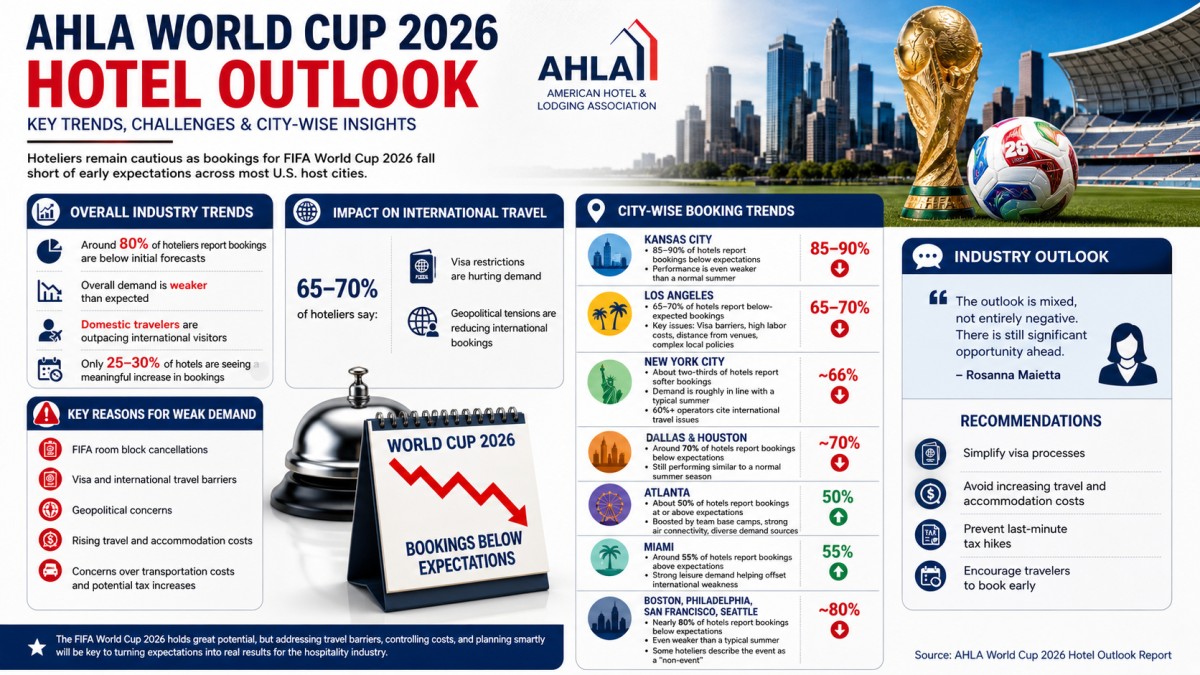
The AHLA World Cup 2026 Hotel Outlook report reveals that nearly 80% of hoteliers across host cities are experiencing bookings below their initial expectations. This is a striking statistic considering the scale of the tournament, which is expected to draw millions of fans from around the world.
Even more telling is that only 25–30% of hotels report any meaningful increase in bookings. Instead of the anticipated international influx, domestic travelers are currently leading demand, suggesting a shift in travel patterns.
In many markets, booking levels are not only underperforming expectations but are also comparable to—or even weaker than—a typical summer season. This raises concerns about whether the World Cup will deliver the economic boost many cities had hoped for.
Key Factors Behind Weak Demand
Several overlapping challenges are contributing to the softer-than-expected booking trends:
1. FIFA Room Block Cancellations
Hotels had initially reserved large blocks of rooms for FIFA-related bookings. However, cancellations or adjustments to these allocations have disrupted anticipated occupancy rates, leaving hotels scrambling to fill inventory.
2. Visa and Travel Barriers
A significant portion of hoteliers—around 65–70%—believe that visa restrictions and entry complexities are discouraging international visitors. For a global event, ease of travel is critical, and current barriers appear to be limiting inbound tourism.
3. Geopolitical Uncertainty
Global tensions and economic uncertainty are also playing a role. Travelers may be hesitant to commit to long-haul trips amid unpredictable international conditions.
4. Rising Costs
Travel has become more expensive across the board. Airfare, accommodation, and local transportation costs have all increased, making World Cup trips less accessible for many fans.
5. Tax and Policy Concerns
Potential tax hikes and complex local regulations in some cities are adding another layer of hesitation for both travelers and hospitality operators.
International Travel: A Critical Weak Spot
The World Cup traditionally thrives on international attendance. However, the AHLA report indicates that this segment is currently underperforming.
- 65–70% of hoteliers report that visa restrictions are directly impacting bookings
- A similar percentage cite geopolitical tensions as a deterrent
This is particularly concerning because international visitors typically stay longer and spend more than domestic travelers. Without strong global participation, the economic upside of the tournament could be significantly reduced.
City-by-City Performance Breakdown
The report highlights major differences in how host cities are performing, revealing a highly uneven landscape.
Kansas City
Kansas City is among the hardest-hit markets, with 85–90% of hotels reporting bookings below expectations. Even compared to a normal summer, performance is weaker—an alarming sign for a host city.
Los Angeles
In Los Angeles, 65–70% of hotels are seeing underwhelming demand. Challenges include:
- Visa barriers
- High labor costs
- Distance between venues
- Complex local policies
Despite being a global tourism hub, these factors are dampening momentum.
New York City
Roughly two-thirds of hotels in New York City report softer bookings. Demand is currently aligned with a typical summer rather than a major global event. Over 60% of operators cite international travel issues as the main concern.
Dallas & Houston
Both cities show similar patterns:
- Around 70% of hotels report below-expected bookings
- Performance remains comparable to a normal summer
While not disastrous, the lack of a significant uplift is notable.
Atlanta
Atlanta stands out as a relative success story. About 50% of hotels report bookings at or above expectations. Key advantages include:
- Hosting team base camps
- Strong air connectivity
- Diverse sources of demand
Miami
Miami is another bright spot, with 55% of hotels exceeding expectations. Strong leisure travel demand is helping offset weaker international arrivals.
Boston, Philadelphia, San Francisco, Seattle
These cities face some of the toughest conditions:
- Nearly 80% of hotels report bookings below expectations
- Demand is even weaker than a typical summer
- Some hoteliers have gone as far as calling the event a “non-event” in terms of impact
A Mixed but Not Hopeless Outlook
Despite the challenges, industry leaders are not entirely pessimistic. Rosanna Maietta, representing the AHLA, describes the outlook as “mixed, not entirely negative.”
There is still time for demand to improve as the tournament approaches. Historically, large events often see late booking surges, especially from international travelers once logistics become clearer.
What Needs to Change?
To unlock the full potential of the World Cup, the report outlines several key recommendations:
Simplify Visa Processes
Streamlining visa approvals could significantly boost international travel. Faster and more transparent systems would encourage more fans to attend.
Control Travel Costs
Keeping airfare, accommodation, and local expenses in check will make the event more accessible.
Avoid Last-Minute Tax Increases
Sudden cost hikes can deter travelers and create uncertainty in the market.
Encourage Early Bookings
Marketing campaigns and incentives can help drive earlier commitments, improving visibility for hotels and organizers.
The Bigger Picture: Expectations vs Reality
The findings from the AHLA highlight an important lesson: mega-events do not automatically guarantee economic windfalls. While the FIFA World Cup remains one of the largest sporting events globally, its impact depends heavily on execution, accessibility, and global conditions.
For hoteliers, the gap between expectations and reality underscores the need for flexible pricing strategies, targeted marketing, and diversified demand sources.
Conclusion
The AHLA World Cup 2026 Hotel Outlook paints a nuanced picture of the hospitality landscape. While the event still holds enormous potential, current booking trends suggest that challenges—particularly around international travel—must be addressed quickly.
Cities like Atlanta and Miami offer proof that strong infrastructure and diversified demand can drive success. Meanwhile, underperforming markets highlight the risks of relying too heavily on projected international influx.
With time still on the clock, stakeholders have an opportunity to adjust strategies, remove barriers, and ensure that the World Cup delivers on its promise—not just for fans, but for the entire hospitality industry.
Disclaimer
This article is for informational and analytical purposes only. The data is based on industry reports and may change as new developments emerge. Readers are advised to refer to official sources and updates for the latest information.


One thought on “AHLA World Cup 2026 Hotel Outlook: Why Bookings Are Falling Short”