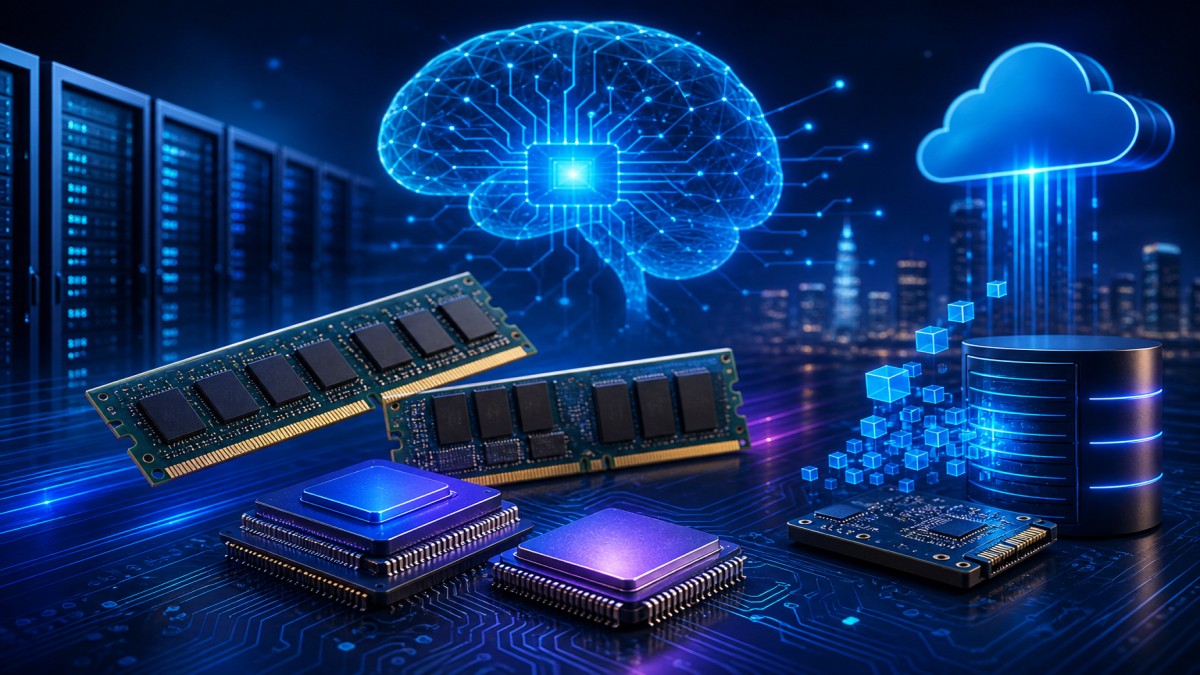
Micron Technology and the AI Memory Boom: Why DRAM, NAND, and Cloud Are Powering the Next Market Surge
The Backbone of the AI Revolution
Artificial Intelligence is no longer a futuristic concept—it is the driving force behind today’s technological and financial markets. While much of the spotlight has been on GPUs and AI models, a quieter yet equally critical component is rapidly gaining investor attention: memory and storage.
Companies like Micron Technology, Inc., SanDisk, and Alphabet Inc. are emerging as key beneficiaries of this transformation. At the center of this shift lies a powerful dynamic—AI’s insatiable demand for DRAM, NAND, and High Bandwidth Memory (HBM).
This article explores why the AI memory boom could reshape the semiconductor landscape and why Micron, in particular, is being viewed as one of the most compelling investment opportunities today.
Micron’s Investment Thesis: A Deep Value Play in AI
According to Mizuho TMT analyst Jordan Klein, the memory sector is entering a powerful upcycle fueled by AI infrastructure growth. His stance is unequivocal—he is “extremely bullish” on DRAM and memory.
Micron stands out for several reasons:
- It is a global leader in DRAM and memory solutions
- It is deeply integrated into the AI hardware ecosystem
- It is currently trading at significantly lower valuations than peers
Despite its strong positioning, Micron is valued at roughly 3–4x buy-side EPS, making it one of the cheapest semiconductor plays relative to its growth potential.
In a market where AI-related stocks often trade at premium multiples, Micron’s valuation presents a rare combination of growth and value.
Supply-Demand Imbalance: The Catalyst for Price Surge
One of the most critical factors driving the bullish outlook for memory stocks is the tightening supply-demand balance.
What’s happening in the market?
- Memory supply is shrinking due to disciplined production
- Demand is exploding due to AI infrastructure expansion
- No major supply additions are expected until H2 2027
This imbalance creates a classic economic scenario: rising prices.
As demand continues to outpace supply, DRAM and NAND prices are expected to increase significantly, boosting revenue and margins for companies like Micron.
AI and Memory: An Interdependent Relationship
AI systems are not just compute-heavy—they are memory-intensive.
Every AI workload requires:
- Massive datasets
- Fast data access
- High-speed processing
This creates a direct relationship:
More AI servers → More CPUs → More DRAM & HBM demand
High Bandwidth Memory (HBM): The Game Changer
HBM is a specialized type of memory designed for high-performance computing and AI workloads. It enables faster data transfer between processors and memory units.
Current market dynamics:
- HBM demand is 3x higher than available supply
- AI accelerators and GPUs heavily depend on HBM
- Supply constraints are expected to persist for years
This makes HBM one of the most strategic assets in the semiconductor industry today—and Micron is a key player in this space.
Micron’s Growth Outlook: Explosive Numbers Ahead
Micron’s financial projections reflect the strength of this trend.
Near-Term Growth
- Sales growth: +200% YoY
- Earnings growth: +600%
FY27 Outlook
- Sales: +60%
- Earnings: +65%
These numbers are not just impressive—they indicate a structural shift in demand rather than a temporary spike.
Micron is also maintaining a Zacks Rank #1 (Strong Buy), reinforcing confidence among analysts.
SanDisk: Riding the NAND and Storage Wave
While DRAM powers computation, NAND powers data storage, and that’s where SanDisk comes in.
AI applications generate enormous volumes of data, requiring:
- Cloud storage
- Data centers
- Edge storage devices
SanDisk is benefiting from all three.
Key Growth Drivers
- AI-driven data centers
- Cloud computing expansion
- Edge devices (IoT, smart systems)
Financial Growth Estimates
- Revenue: $16.5B (up 120% YoY)
- Earnings growth:
- +1500% (current fiscal year)
- +170% (FY27)
Rising NAND prices further strengthen SanDisk’s outlook, making it one of the most compelling storage plays in the AI ecosystem.
Alphabet and Google Cloud: AI Demand at Scale
The impact of AI is not limited to hardware—it is transforming cloud computing as well.
Alphabet Inc. has delivered strong financial performance, driven largely by its cloud division.
Key Highlights
- EPS beat expectations by 90%+
- Revenue surprise: +2.7%
- Google Cloud revenue: $20B
- Growth rate: +62.7% YoY
Google Cloud is seeing massive demand from companies deploying AI models, training data, and running inference workloads.
This creates a feedback loop:
More AI adoption → More cloud usage → More data → More storage & memory demand
The AI Feedback Loop: A Self-Reinforcing Cycle
The AI ecosystem operates on a powerful cycle:
- Increased compute power enables better AI models
- Better AI models drive more applications
- More applications increase data generation
- More data requires more storage and memory
- This fuels demand for semiconductors
This loop is not slowing down—in fact, it is accelerating.
Memory, storage, and cloud are no longer secondary components—they are core pillars of AI growth.
Stock Performance: Micron’s Remarkable Run
Micron’s stock performance reflects growing investor confidence:
- Up ~600% YoY
- Up ~29% in recent months
- Forward P/E: ~5.8x
Despite this rally, the stock remains undervalued relative to its growth trajectory.
Analysts expect Micron’s earnings to increase nearly 10x by 2027, suggesting that the current valuation may still not fully reflect its future potential.
Bull Case: Can Micron Reach $1000?
Investment firm D.A. Davidson has set an ambitious $1000 price target for Micron.
Key Drivers Behind This Bull Case
- Leadership in advanced memory nodes
- Strong positioning in HBM technology
- Longer and more sustained demand cycle than previous semiconductor booms
Unlike past cycles, which were driven by consumer electronics, this cycle is powered by AI infrastructure, which has far deeper and longer-lasting demand.
Market-Wide Impact: AI Lifting the Entire Semiconductor Sector
The strength of AI-driven demand is not limited to individual companies—it is lifting the entire market.
- S&P 500 earnings growth revised from 15% to 21%
- Semiconductor stocks are leading the rally
- AI and chips are now considered the core growth engine of the economy
This shift marks a new era where technology infrastructure—not just software—drives market expansion.
Key Takeaways: The Big Picture
The AI boom is reshaping multiple industries simultaneously:
1. Memory Demand is Exploding
DRAM and HBM are critical for AI workloads, and supply constraints are driving prices higher.
2. Storage is Becoming Essential
NAND demand is surging due to data-heavy AI applications.
3. Cloud is Scaling Rapidly
Companies like Alphabet are seeing unprecedented growth in cloud services.
4. Micron is a Standout Opportunity
With low valuation and high growth, Micron offers a rare combination of value + momentum.
5. AI is Creating a Long-Term Cycle
This is not a short-term trend—it is a multi-year structural shift.
The Silent Giants of AI
While GPUs and AI models dominate headlines, the real backbone of the AI revolution lies in memory and storage.
Companies like Micron, SanDisk, and Alphabet are quietly building the infrastructure that powers everything from chatbots to autonomous systems.
For investors, this presents a compelling opportunity:
- A high-growth sector
- A clear supply-demand imbalance
- A long-term technological shift
If the AI revolution is the engine of future growth, then memory and storage are the fuel that keeps it running.
📊 Related Read
As markets continue to surge on AI-driven optimism, investors are now facing a reality check. The Federal Reserve’s cautious stance, persistent inflation, and rising geopolitical risks are creating uncertainty in the financial landscape.
👉 Market Rally Faces Reality as Fed Signals Caution AheadDisclaimer
This article is for informational purposes only and does not constitute financial advice. Investors should conduct their own research or consult a financial advisor before making investment decisions. Market conditions and forecasts are subject to change, and past performance is not indicative of future results.



One thought on “Micron Technology & AI Memory Boom: Why DRAM, NAND, and Cloud Stocks Are Set to Explode”