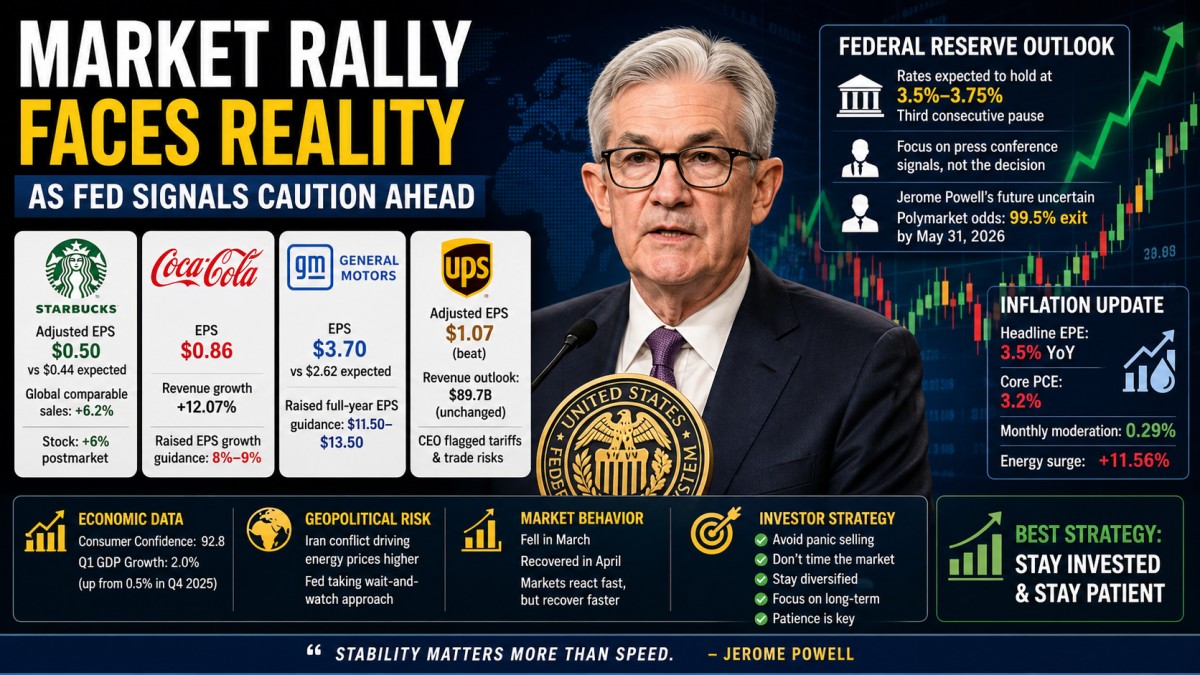
Market Rally Faces Reality as Fed Signals Caution Ahead
The global financial markets are currently navigating a complex and fragile environment where strong corporate earnings, persistent inflation, and geopolitical tensions are colliding. While headline numbers from major corporations appear impressive, a deeper analysis reveals a more cautious outlook among both policymakers and investors.
As the Federal Reserve prepares to maintain its current policy stance, markets are increasingly reacting not to decisions themselves, but to the tone and forward guidance of central bank leadership. This evolving landscape is shaping investor sentiment and redefining strategies for 2026.
Strong Earnings, But With a Catch
The latest earnings season has delivered a wave of optimism on the surface. Major corporations have exceeded analyst expectations, showcasing resilience despite macroeconomic headwinds.
Key Highlights:
- Starbucks
- Adjusted EPS: $0.50 (vs $0.44 expected)
- Global comparable sales: +6.2%
- Stock surged 6% postmarket
- Coca-Cola
- EPS: $0.86
- Revenue growth: +12.07%
- Raised EPS growth outlook to 8%–9%
- General Motors
- EPS: $3.70 (vs $2.62 expected)
- Raised full-year guidance significantly
- United Parcel Service
- Adjusted EPS beat expectations
- Revenue outlook steady at $89.7B
At first glance, these results suggest a strong and resilient corporate environment. However, a crucial pattern is emerging—companies are beating earnings estimates but hesitating to significantly raise forward guidance.
Why This Matters
This divergence between performance and outlook is a warning signal. It indicates that while businesses are managing current conditions effectively, they remain uncertain about the future.
Key concerns include:
- Rising energy prices
- Geopolitical instability
- Trade disruptions
- Inflationary pressures
Federal Reserve: The Real Market Driver
While earnings headlines dominate news cycles, the true driver of market sentiment remains monetary policy.
The Federal Reserve is expected to maintain interest rates within the 3.5%–3.75% range, marking the third consecutive pause.
However, the real focus is not the decision itself—but the messaging from Fed Chair Jerome Powell.
Why Powell’s Tone Matters More Than Policy
Markets have largely priced in the current rate pause. Therefore, any significant movement will depend on:
- Forward guidance
- Inflation outlook
- Labor market commentary
- Geopolitical risk assessment
Investors are closely analyzing Powell’s statements for clues about future rate cuts or hikes.
Inflation: The Sticky Challenge
Inflation continues to remain a major concern for policymakers.
Latest Inflation Data:
- Headline PCE: 3.5% YoY
- Core PCE: 3.2%
- Monthly increase: 0.29%
- Energy prices surged: +11.56%
Interpretation:
- Headline inflation remains sticky
- Core inflation is gradually cooling
This mixed trend complicates the Fed’s decision-making process. While easing core inflation suggests progress, elevated headline numbers—driven largely by energy—prevent aggressive policy shifts.
Geopolitical Risks: The Iran Conflict Impact
Global tensions, particularly the ongoing Iran-related conflict, are adding another layer of uncertainty.
Key Effects:
- Rising oil prices
- Increased volatility in energy markets
- Supply chain disruptions
- Heightened global economic uncertainty
The Federal Reserve has adopted a wait-and-watch approach, recognizing that premature policy changes could destabilize markets further.
Powell has emphasized that Middle East tensions represent a significant unknown factor for economic forecasts.
Economic Data Shows Mixed Signals
Despite global uncertainty, recent macroeconomic indicators suggest underlying strength in the economy.
Key Data Points:
- Consumer Confidence: 92.8 (above expectations)
- GDP Growth (Q1 2026): 2.0%
- Previous Quarter (Q4 2025): 0.5%
What This Means
The economy is showing signs of recovery and resilience. However, this growth comes with a trade-off—persistent inflation.
This creates a policy dilemma:
- Strong growth supports higher rates
- Inflation requires caution
- Markets demand clarity
Market Behavior: Volatile Yet Resilient
Recent market movements highlight how quickly sentiment can shift.
Observed Trends:
- March: Significant decline due to uncertainty
- April: Strong recovery following easing tensions
Key Insight:
Markets are:
- Highly reactive to news
- Quick to recover when uncertainty reduces
This behavior underscores the importance of avoiding emotional decision-making.
Investor Warning: Proceed With Caution
Financial institutions like Charles Schwab have issued clear warnings.
“Traders need to be really careful.”
Why the Warning?
- Fed decisions already priced in
- Market movements depend on subtle signals
- High volatility expected
Investors who rely on short-term speculation may face increased risks in this environment.
Sector-Wise Impact Analysis
Different sectors are responding differently to current conditions.
Interest Rate Sensitive Sectors:
- Technology
- Growth stocks
These sectors are:
- Highly dependent on borrowing costs
- Sensitive to rate changes
Cyclical & Macro-Driven Sectors:
- Banking
- Energy
These sectors benefit from:
- Economic expansion
- Higher interest rates (for banks)
- Rising oil prices (for energy companies)
Smart Investment Strategies for 2026
Given the current environment, investors need to adopt a disciplined and strategic approach.
What to Avoid:
- Panic selling during volatility
- Trying to time the market
- Overreacting to news headlines
What to Focus On:
1. Long-Term Investing
Markets fluctuate in the short term but reward patience over time.
2. Diversification
Spread investments across:
- Sectors
- Asset classes
- Geographies
3. Fundamentals Over Hype
Focus on:
- Earnings quality
- Balance sheets
- Growth potential
4. Stay Disciplined
Avoid emotional decisions driven by fear or greed.
The Bigger Picture: What Investors Must Understand
The current market environment is not driven by a single factor but a combination of forces:
Key Drivers:
- Strong but cautious corporate earnings
- Persistent inflation
- Federal Reserve’s measured approach
- Geopolitical uncertainty
Reality Check:
- Strong earnings do not guarantee future growth
- Inflation is not fully under control
- Rate cuts are not imminent
- Volatility is here to stay (short-term)
Key Takeaways
- Corporate earnings are strong, but guidance remains cautious
- Inflation continues to challenge policymakers
- Federal Reserve is prioritizing stability over aggressive action
- Geopolitical risks are influencing global markets
- Market volatility is expected but manageable
Final Conclusion: Patience Is the Winning Strategy
The 2026 financial landscape presents a unique mix of optimism and caution. While economic growth is improving and companies are performing well, underlying risks cannot be ignored.
The Federal Reserve is taking a balanced approach, aiming to control inflation without disrupting growth. Meanwhile, investors must navigate uncertainty with discipline and clarity.
The message from Jerome Powell is clear:
Stability matters more than speed.
What Investors Should Do:
- Stay calm during volatility
- Focus on long-term goals
- Maintain diversification
- Avoid impulsive decisions
In a market driven by uncertainty, patience is not just a virtue—it is a strategy.
Disclaimer
The information provided in this article is for informational and educational purposes only and should not be considered as financial, investment, or trading advice. While every effort has been made to ensure the accuracy and reliability of the data presented, the author and publisher make no guarantees regarding completeness, accuracy, or timeliness.
Stock markets and economic conditions are subject to rapid changes due to various factors including market sentiment, geopolitical events, and policy decisions. Any opinions expressed in this article are those of the author and do not constitute recommendations to buy, sell, or hold any securities or financial instruments.
Readers are strongly advised to conduct their own research or consult with a qualified financial advisor before making any investment decisions. The author and publisher shall not be held responsible for any financial losses or damages resulting from the use of this information.
Investing in financial markets involves risk, including the potential loss of principal.


2 thoughts on “Market Rally Faces Reality as Fed Signals Caution Ahead”