Netflix has built a reputation for releasing fast-paced action comedies led by some of Hollywood’s biggest stars, and 72 Hours follows that familiar formula. Directed by Tim Story, the filmmaker behind hits like Ride Along and Barbershop, the movie pairs Kevin Hart’s signature comedic style with an intergenerational premise that initially promises something more thoughtful than the average buddy comedy.
At its core, 72 Hours explores a relatable modern dilemma: what happens when someone who has built a successful career suddenly realizes they no longer understand the culture shaping the next generation? It is a timely idea, especially in an era where social media trends, internet slang, and online communities evolve almost overnight.
Unfortunately, while the film introduces this concept with genuine potential, it gradually abandons it in favor of increasingly outrageous action sequences and exaggerated slapstick. The result is a comedy that delivers occasional laughs but never fully capitalizes on its strongest ideas.
A Premise Built for Modern Comedy
Kevin Hart stars as Joe, a 40-year-old marketing executive struggling to reconnect with younger consumers. During an important presentation for a new vodka campaign, Joe discovers that his understanding of youth culture is badly outdated.
His boss makes it clear that remaining relevant is no longer optional. If Joe cannot adapt to the tastes and behaviors of Generation Z, his career may begin moving in the wrong direction.
This setup immediately creates an interesting conflict. Today’s workplace increasingly brings Millennials and Gen Z employees together, often exposing differences in communication styles, technology habits, humor, and expectations. A comedy centered around these cultural differences could have delivered clever observations about modern life.
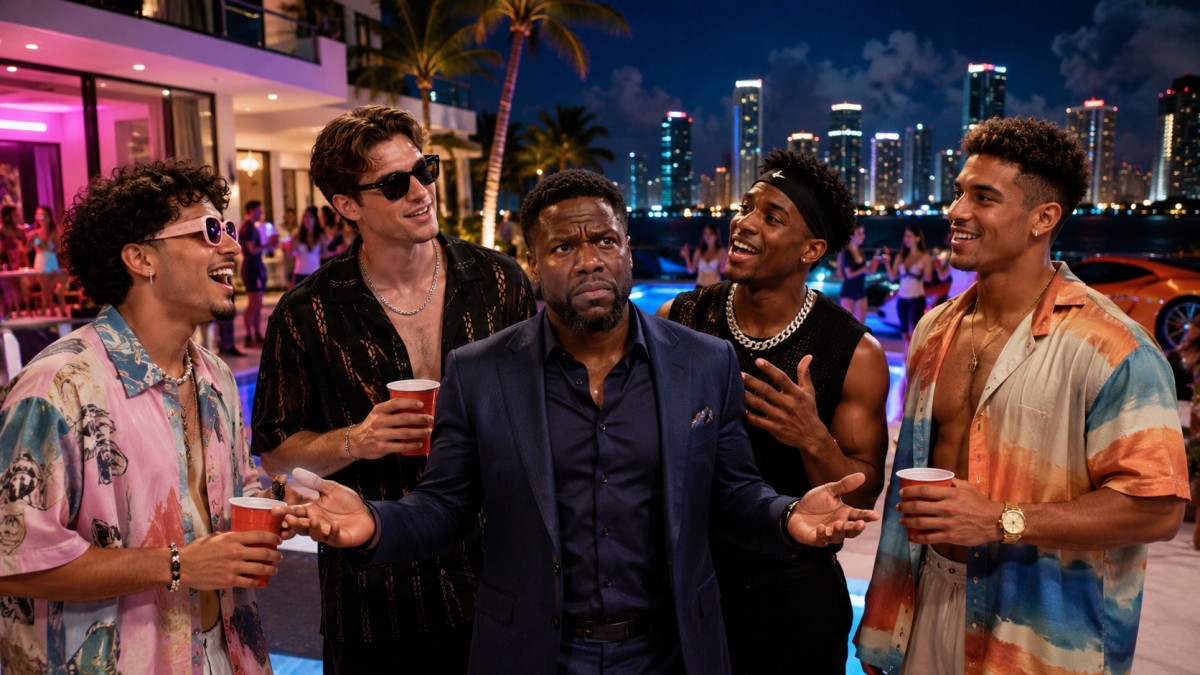
Instead of learning through research or mentoring, Joe accidentally becomes part of a bachelor party group chat after sending money to someone he doesn’t know. The misunderstanding leads to an invitation to spend an entire weekend with several twenty-somethings heading to Miami.
Believing the trip could help him better understand younger audiences, Joe decides to join them despite objections from his longtime girlfriend.
The setup is fresh enough to spark curiosity.
Kevin Hart Remains the Driving Force
Kevin Hart has spent years establishing himself as one of Hollywood’s most dependable comedic performers. His greatest strength has always been his physical comedy, expressive reactions, and ability to maintain high energy regardless of the material.
That consistency continues in 72 Hours.
Joe constantly finds himself trapped in absurd situations, forcing Hart to rely on exaggerated facial expressions, frantic movement, and rapid-fire dialogue. Even when individual jokes fail to land, his commitment keeps many scenes entertaining.
Hart throws himself into every chaotic sequence with complete confidence.
Whether he’s escaping dangerous criminals, surviving bizarre accidents, or desperately attempting to blend in with people much younger than himself, his enthusiasm rarely fades.
The performance reminds viewers why Hart remains one of Netflix’s most reliable comedy stars.
The Film Quickly Leaves Its Best Idea Behind
The first act suggests audiences are about to watch a comedy built around generational misunderstandings.
Joe struggles to understand internet slang.
He cannot keep up with social media habits.
He feels noticeably older than everyone around him.
These moments hint at a satire exploring how quickly culture evolves.
Unfortunately, once the bachelor party reaches Miami, those themes largely disappear.
Rather than examining generational differences, the movie shifts toward nonstop misunderstandings involving criminals, mistaken identities, elaborate chase scenes, and increasingly ridiculous action.
Instead of asking how Millennials and Gen Z view the world differently, the film asks viewers to accept increasingly unbelievable situations simply because they create opportunities for slapstick humor.
The change in direction feels abrupt.
Miami Becomes a Playground for Chaos
The bachelor party takes place inside an extravagant mansion with a mysterious criminal history.
From there, events spiral completely out of control.
Joe is repeatedly mistaken for different people, including individuals connected to dangerous criminal organizations.
Every attempt to solve one problem creates another.
The film piles misunderstanding upon misunderstanding until logic becomes secondary to spectacle.
There are limousine fights, high-speed chases, confrontations with gangsters, bizarre smuggling operations, and several scenes designed purely for visual comedy.
The escalation never really stops.
Viewers looking for nonstop chaos may appreciate the film’s relentless pace, but anyone hoping for grounded character-driven comedy may find the experience exhausting.
Supporting Cast Adds Energy
The younger cast brings enthusiasm throughout the film.
Marcello Hernández, Ben Marshall, Kam Patterson, and Mason Gooding create a believable group of friends whose carefree personalities sharply contrast Joe’s increasingly desperate attempts to fit in.
Although the screenplay rarely allows these characters much emotional depth, they provide enough chemistry to make the bachelor party feel authentic.
Teyana Taylor appears as Joe’s girlfriend, serving as the voice of reason whenever his decisions become increasingly reckless.
While Taylor delivers a confident performance, her character receives limited development.
Much of her screen time revolves around reacting to Joe’s poor choices rather than pursuing her own storyline.
Considering Taylor’s recent dramatic work, audiences may wish the film gave her a larger role.
Action Often Overshadows Comedy
Tim Story has directed several successful action comedies, and his experience is visible throughout 72 Hours.
The pacing rarely slows.
Explosions, fights, car chases, and physical comedy arrive in rapid succession.
However, the emphasis on spectacle sometimes comes at the expense of humor.
Many jokes rely on repetition rather than clever writing.
Several scenes stretch simple gags far beyond their natural lifespan, reducing their impact.
The movie occasionally mistakes louder for funnier.
Instead of allowing awkward conversations and cultural misunderstandings to generate laughs organically, it frequently interrupts those moments with another elaborate action sequence.
That creative choice shifts the film away from satire and toward broad physical comedy.
Comedy That Divides Audiences
Like many Kevin Hart comedies, 72 Hours will likely divide audiences based on personal taste.
Fans who enjoy exaggerated slapstick, nonstop misunderstandings, and outrageous scenarios may find plenty to enjoy.
Others may feel the screenplay relies too heavily on predictable formulas.
Several comic sequences become increasingly absurd without building meaningful tension or emotional investment.
The humor often depends on characters behaving irrationally simply to extend the chaos.
There are occasional clever moments scattered throughout the film, but they rarely connect into a larger comedic rhythm.
Instead, the experience resembles a collection of energetic sketches held together by a loose narrative.
Familiar Storytelling Limits the Film
One of the movie’s biggest weaknesses is its unwillingness to fully embrace its strongest concept.
Modern workplaces continue experiencing fascinating shifts as different generations collaborate more closely than ever before.
Questions about technology, communication, career expectations, and cultural identity could have produced sharp observational comedy.
Instead, those ideas remain mostly surface-level.
The screenplay appears more interested in escalating increasingly ridiculous scenarios than exploring meaningful differences between generations.
As a result, the story ultimately becomes another mistaken-identity action comedy rather than the smart workplace satire its opening promises.
Technical Presentation
Visually, 72 Hours delivers everything audiences expect from a modern streaming comedy.
Miami provides colorful locations, luxury homes, energetic nightlife, and scenic waterfront views that create an attractive backdrop.
The cinematography keeps the action easy to follow while maintaining a lively atmosphere.
Editing remains fast throughout, helping sustain momentum even when jokes fall flat.
The soundtrack features contemporary music that complements the younger cast and reinforces the film’s energetic tone.
Production values remain consistently polished, reflecting Netflix’s investment in high-profile original releases.
Is 72 Hours Worth Watching?
Despite its shortcomings, 72 Hours is never completely boring.
Kevin Hart’s commitment prevents the film from collapsing under its increasingly outrageous premise.
His charisma carries many scenes that otherwise might struggle to generate laughs.
The supporting cast contributes solid performances, and Tim Story maintains an energetic pace from beginning to end.
However, viewers expecting insightful commentary about Millennials versus Generation Z may leave disappointed.
The film introduces an excellent idea but gradually replaces thoughtful comedy with exaggerated action and nonstop slapstick.
There are entertaining moments, memorable visual gags, and enough momentum to make the movie an easy weekend watch.
Yet there is also a lingering sense that a far more original comedy was hiding beneath all the chaos.
72 Hours is a fast-moving Netflix comedy that prioritizes energy over substance. Kevin Hart once again proves why he remains one of Hollywood’s most dependable comedic performers, delivering a committed performance filled with physical humor and relentless enthusiasm.
While the film succeeds as light entertainment, it falls short of becoming the sharp generational comedy its premise initially suggests. Instead of fully exploring the cultural divide between Millennials and Gen Z, it settles for familiar action-comedy formulas and increasingly outrageous situations.
For audiences simply looking for a fun, undemanding comedy with plenty of chaos and Kevin Hart’s trademark style, 72 Hours offers enough entertainment to justify a viewing. Those hoping for a smarter, more satirical exploration of modern generational culture, however, may find themselves wishing the movie had trusted its original concept just a little more.
Source: Adapted and independently written using reporting and review insights from The Hollywood Reporter.