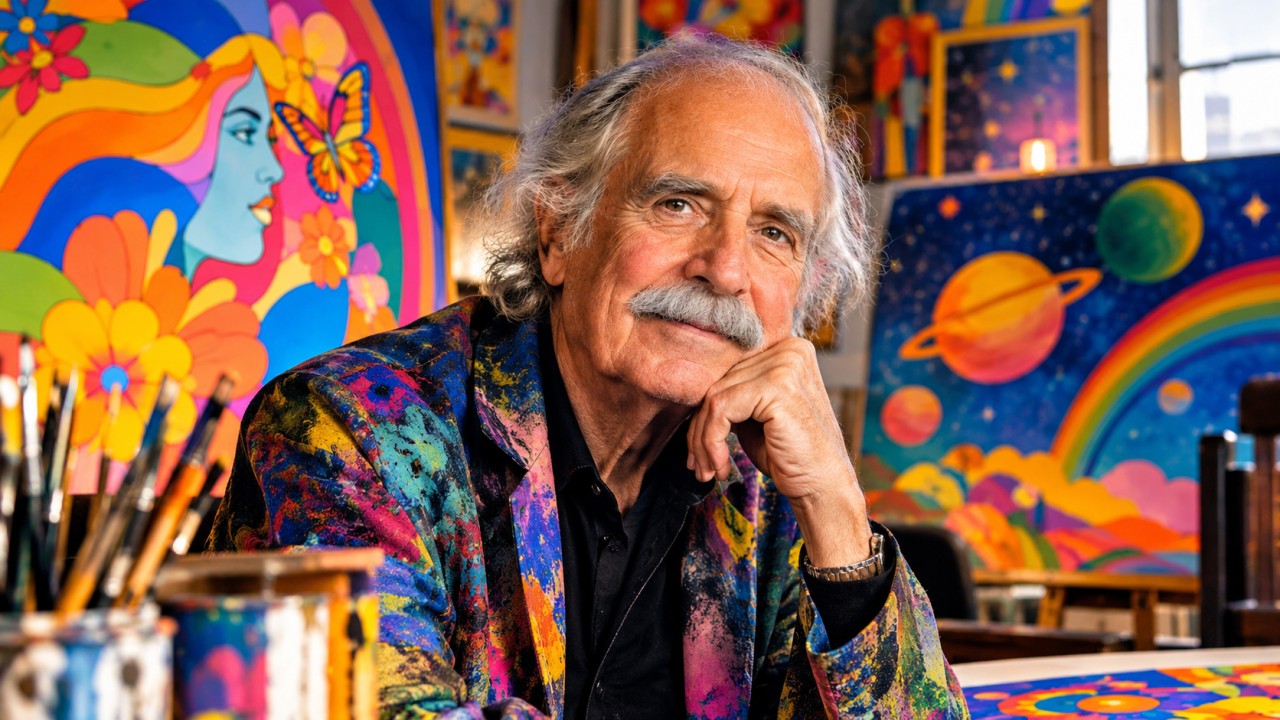
Peter Max, the colorful German-American artist whose bold designs became closely associated with the counterculture of the 1960s and 1970s, has died at the age of 88.
Max died Monday at a Manhattan hospital following a long battle with Alzheimer’s disease, according to his longtime friend and spokesperson Michael Pagnotta. He is survived by his children, Max and Libra.
For generations of Americans, Max’s work was instantly recognizable. His paintings and posters combined vivid colors, cosmic imagery, flowing lines and optimistic themes, creating a visual style that became one of the defining artistic signatures of an era.
A Childhood Shaped by War and Immigration
Max was born Peter Max Finkelstein in Berlin in 1937 to Jewish parents. His family left Germany when he was an infant as Nazi persecution intensified.
The family eventually spent roughly a decade in Shanghai before moving to Israel. Several years later, Max relocated to the United States and settled in Brooklyn in 1953.
His international childhood experiences and exposure to different cultures would become important influences on his artistic development.
After finishing high school, Max studied at the Art Students League of New York, an institution associated with several influential American artists. His artistic career developed during a period when American art was rapidly changing and traditional boundaries were being challenged.
The Artist Behind the Psychedelic Look
Max became known for a distinctive visual language filled with saturated colors, stars, planets, rainbows, faces and dreamlike figures.
His work became particularly popular during the cultural transformation of the late 1960s. At a time when music, fashion and youth culture were undergoing dramatic changes, Max’s artwork provided a colorful visual counterpart to the era.
One of his best-known works was the “Be In” poster, which incorporated the word “Love” into a rainbow-filled design. The image became associated with the counterculture movement and New York’s late-1960s gatherings.
Another memorable creation was his “Cosmic Jumper,” a floating human figure dressed in a colorful bell-bottomed outfit. The character became one of Max’s signature images and was later featured on a U.S. postage stamp connected to the 1974 Spokane World’s Fair.
From Posters to Everyday American Life
Max’s popularity extended well beyond galleries and art exhibitions.
His brightly colored creations appeared on a wide range of consumer products, allowing his artwork to reach Americans who might never have visited an art museum. His designs were reproduced on items ranging from clothing accessories to household products.
His commercial approach reflected a philosophy that art should be available to ordinary people rather than being limited to collectors and institutions.
That accessibility helped turn Max into more than a traditional fine artist. His imagery became part of American popular culture.
Peter Max and the U.S. Government
One of the more unusual chapters in Max’s career came when the U.S. government asked him during the 1970s to create designs for “Welcome to the U.S.” signs at border crossings.
The proposed signs featured the artist’s unmistakable use of bright colors and energetic imagery. Some officials initially questioned whether the psychedelic designs were appropriate for international entry points, and the signs were temporarily placed in storage.
The project was later brought back under President Jimmy Carter. By 1978, more than 100 of Max’s signs had reportedly been installed at border crossings along the Canadian and Mexican borders.
The project gave his artwork an unusual public role: his colorful designs were not simply hanging in private homes or galleries but were greeting international travelers entering the United States.
His Art Became Part of Music and Pop Culture
Max’s name became strongly associated with the cultural atmosphere surrounding the Beatles and the psychedelic era, although he did not create the artwork for the Beatles’ 1969 animated film “Yellow Submarine.”
That movie’s distinctive visual style was created by Czech-German illustrator Heinz Edelmann, whose work sometimes led to comparisons with Max’s colorful aesthetic.
Throughout his career, Max also created portraits and artwork connected to numerous famous figures. His subjects and commissions eventually extended across entertainment, politics and American public life.
His visual style remained recognizable even as popular culture changed dramatically around him.
A Spiritual Influence on His Work
Max often described creativity in philosophical and spiritual terms.
In his 2013 book “The Universe of Peter Max,” he reflected on the people and ideas that influenced his life, including yoga teacher Swami Satchidananda.
Max viewed the universe itself as a source of creative inspiration and frequently incorporated celestial imagery into his artwork. Stars, planets and cosmic landscapes became recurring elements throughout his career.
The artist’s fascination with the universe also connected his work with America’s growing interest in space exploration and science during the second half of the 20th century.
Astrophysicist Neil deGrasse Tyson contributed the introduction to Max’s 2013 visual memoir, highlighting the artist’s fascination with the cosmos.
A Legacy That Reached Millions
Peter Max’s influence was unusual because his art existed simultaneously in galleries, homes, advertising, consumer products and public spaces.
His brightly colored posters became familiar decorations in American homes, college dormitories and offices. His designs also appeared on commercial merchandise, making his artistic signature recognizable to people far beyond the traditional art world.
While the cultural landscape that first made Max famous eventually changed, his visual language remained closely tied to the optimism and experimentation of the 1960s and 1970s.
For many Americans, Peter Max represented a period when art, music, fashion and youth culture were increasingly blending together.
His career ultimately demonstrated how an artist could move between fine art and mass culture without abandoning a distinctive personal style.
Peter Max leaves behind a body of work that helped give one of America’s most transformative cultural periods its unmistakable visual identity.
Disclaimer: This article is based on publicly reported information. Details surrounding Peter Max’s death and career are attributed to the sources cited and may be updated as new information becomes available.