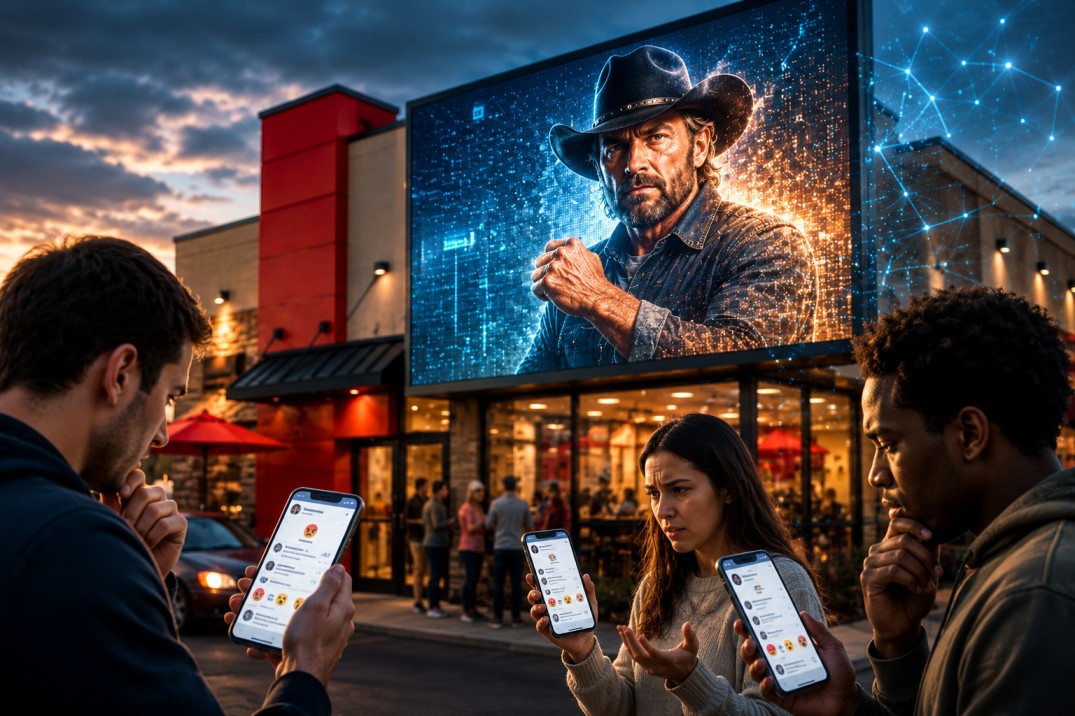
The growing use of artificial intelligence in advertising has once again ignited a nationwide conversation, this time centered on one of America’s most recognizable action heroes. Raising Cane’s recently launched a campaign featuring a digitally recreated version of Chuck Norris, prompting widespread discussion about the ethics of AI-generated celebrity endorsements, even when they are supported by the celebrity’s family.
The campaign was introduced as part of National Chicken Finger Day, an annual promotion that also serves a charitable purpose. While many customers welcomed the fundraising effort, others focused less on the cause and more on the technology behind the advertisements. Across social media platforms, reactions ranged from curiosity to concern, with critics questioning whether AI-generated likenesses should become a normal part of modern marketing.
A Charity Campaign With a Digital Twist
Raising Cane’s announced that it would donate $1 from every Box Combo sold on National Chicken Finger Day, up to $1 million, to support Kickstart Kids, the youth development organization co-founded by Chuck Norris. The nonprofit has spent years helping young people build confidence, discipline, and leadership skills through martial arts programs.
To promote the campaign, the restaurant chain released television commercials, digital advertisements, social media content, billboards, and in-store displays featuring an AI-generated version of Norris. The campaign also includes appearances from members of the Norris family alongside Raising Cane’s founder Todd Graves.
Company officials say the project was developed with the knowledge and encouragement of Chuck Norris’ family, who viewed it as an opportunity to continue supporting the charitable mission that meant so much to him.
Social Media Users React Quickly
Despite the charitable objective, much of the online conversation centered on the use of artificial intelligence rather than the donation campaign itself.
Users across X (formerly Twitter), Reddit, TikTok, and other social platforms criticized the advertisements, with some describing them as unsettling and emotionally uncomfortable. Others questioned whether AI should be used to recreate public figures after their passing, regardless of legal approval.
Several posts that gained traction described the campaign as “dystopian,” while others argued that companies should invest in traditional creative work instead of relying on generative AI technology.
Some viewers expressed disappointment because Chuck Norris built his career through authentic performances and believed a digital recreation did not capture the personality that made him an American icon.
However, not every reaction was negative. Some users defended the campaign, noting that the proceeds benefit a respected nonprofit organization and that the Norris family publicly supported the project. Supporters argued that if the family approved the campaign, the criticism should focus on the technology itself rather than the company’s intentions.
Family Approval Changes the Conversation
One of the most significant aspects of the campaign is the involvement of Chuck Norris’ family.
According to Raising Cane’s, the advertisements were created with their cooperation and blessing. Family members have described the project as a respectful tribute designed to continue Norris’ legacy while raising money for programs that help young people across the United States.
That approval distinguishes this campaign from many previous AI controversies involving celebrities, where digital recreations appeared without permission from estates or family representatives.
Supporters say this demonstrates how artificial intelligence can be used responsibly when creators obtain proper authorization and clearly communicate the purpose behind the project.
Why AI Advertising Remains So Controversial
Artificial intelligence is rapidly becoming part of modern advertising. Companies now use AI to generate voices, images, video effects, and even entirely digital spokespersons.
While the technology offers creative flexibility and lower production costs, it also raises important ethical questions:
- Should deceased celebrities appear in new advertisements?
- How much creative control should families or estates have?
- Will AI reduce opportunities for actors, artists, designers, and filmmakers?
- Can audiences always distinguish between real and AI-generated content?
Marketing experts say public trust depends heavily on transparency. Consumers generally respond more positively when companies openly disclose the use of AI instead of presenting digital recreations as authentic footage.
The Raising Cane’s campaign has become another example of how quickly audiences notice AI-generated content and how strongly they react to its use.
Earlier AI Misinformation Added Sensitivity
The discussion surrounding this campaign comes only months after Chuck Norris’ family publicly condemned false AI-generated content circulating online.
Following the actor’s death, fabricated videos and images spread across social media claiming to show events that never happened or providing inaccurate information about his health and personal life.
The family urged fans to rely only on official statements and warned against sharing misleading AI-generated posts.
Because of those earlier experiences, some observers were surprised to see the family later support an AI-assisted advertising campaign. Others argue the situations are fundamentally different.
In one case, misleading AI content attempted to spread false information. In the other, the technology was used with family approval to support a verified charitable initiative.
A Sign of Where Advertising Is Headed
The Raising Cane’s campaign reflects a larger shift taking place throughout the advertising industry.
Brands are increasingly experimenting with artificial intelligence to produce commercials faster, personalize marketing, and recreate historical figures or celebrities with permission. Major entertainment studios, sports organizations, and retail companies have all explored similar technologies in recent years.
As AI tools become more advanced, experts expect debates over authenticity, consent, and creative ethics to become even more common.
For businesses, the challenge will be balancing innovation with public expectations. While AI can create visually impressive campaigns, consumer reactions suggest that emotional authenticity still matters.
Public Opinion Remains Divided
The response to Raising Cane’s latest campaign illustrates how complicated AI-generated advertising has become.
For some Americans, the campaign represents a thoughtful tribute that supports a meaningful cause while celebrating Chuck Norris’ legacy with the approval of those closest to him.
For others, it serves as another reminder of how artificial intelligence is reshaping entertainment and advertising in ways that feel unfamiliar or uncomfortable.
Regardless of where consumers stand, the campaign has accomplished one thing beyond promoting National Chicken Finger Day—it has fueled a national discussion about the future of AI in marketing.
As artificial intelligence continues to influence advertising across the United States, brands will likely face increasing pressure to balance technological innovation with transparency, ethics, and respect for the individuals whose images and legacies they choose to preserve.
Disclaimer: This article is based on publicly available reports and online reactions. It is intended for informational purposes only and does not represent the official views of Raising Cane’s, the Chuck Norris family, or any affiliated organization.