FIFA World Cup 2026: Glory, Greed, and the Growing Crisis Behind Football’s Biggest Stage
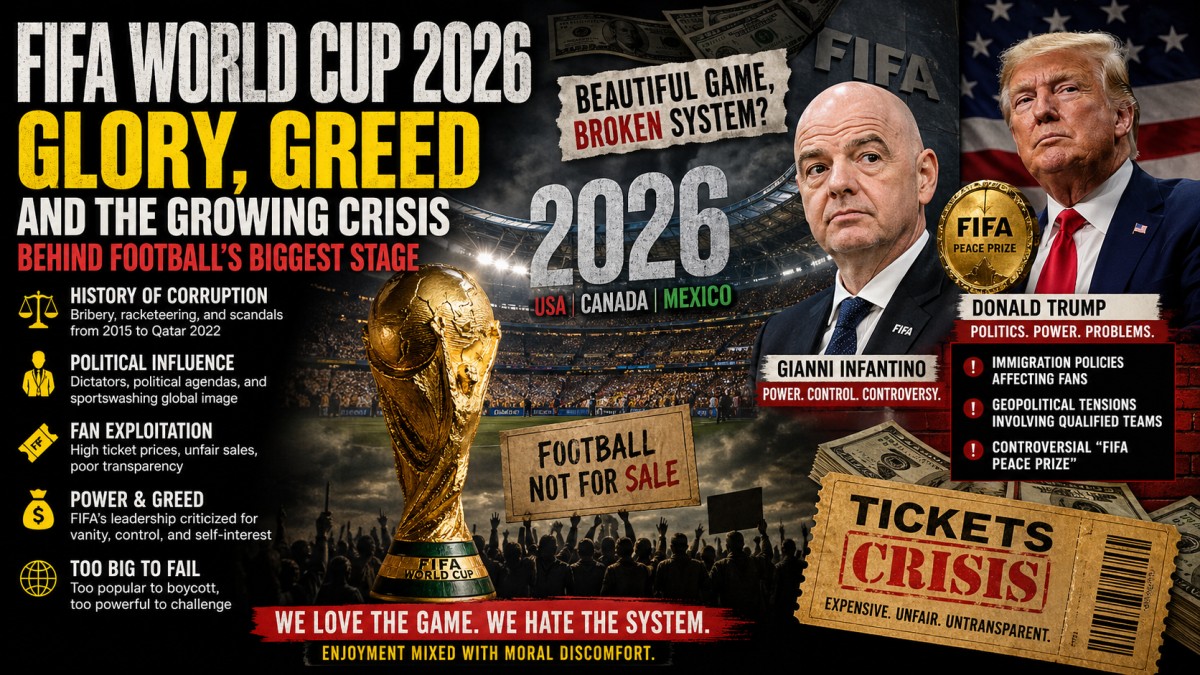
The FIFA World Cup is often described as the greatest spectacle in sports — a global celebration that unites billions. Yet behind the dazzling goals, roaring crowds, and national pride lies a darker, deeply controversial reality.
Over the years, FIFA has transformed from a regulatory body into a powerful institution frequently accused of corruption, political manipulation, and ethical failures. As the world prepares for the 2026 edition, these concerns are no longer whispers — they are loud, visible, and impossible to ignore.
The World’s Richest — and Most Controversial — Sporting Event
The FIFA World Cup is not just a tournament; it is a multi-billion-dollar global industry. Sponsorship deals, broadcasting rights, and ticket revenues make it one of the wealthiest sporting events on Earth.
However, with immense wealth comes immense scrutiny.
Critics argue that FIFA operates with limited accountability despite its global influence. Over decades, allegations of bribery, vote-rigging, and financial misconduct have repeatedly surfaced, painting a picture of an organization driven more by profit and power than by the spirit of football.
The contradiction is striking:
- Fans openly criticize FIFA
- Yet continue to watch, celebrate, and support the World Cup
This paradox lies at the heart of football’s global appeal — and its moral dilemma.
Read Also
Discover the inspiring journey of Cristiano Ronaldo: The Man Who Refused to Be Ordinary — from humble beginnings to becoming one of the greatest footballers in history, with record-breaking goals, five Ballon d’Or awards, and unmatched global influence.
A History of Corruption That Refuses to Fade
FIFA’s reputation took a major hit during the 2015 FIFA corruption scandal, when officials were investigated for racketeering, bribery, and money laundering across multiple countries.
Key controversies included:
- Bribery linked to broadcasting rights deals
- Corrupt bidding processes for hosting tournaments
- Financial irregularities at the highest levels
Perhaps the most widely debated issue was the awarding of the 2022 World Cup to Qatar, which sparked global outrage over transparency and ethics.
Despite reforms and leadership changes, many believe the system itself remains flawed — allowing corruption to persist in new forms.
Sportswashing and Political Power
One of the most serious accusations against FIFA is its role in sportswashing — the use of sports to improve the global image of governments or political figures.
Critics claim that:
- Authoritarian regimes have used the World Cup to legitimize their global standing
- FIFA has prioritized financial deals over ethical considerations
- Political influence often outweighs fair governance
The World Cup, instead of being purely about football, increasingly intersects with global politics, diplomacy, and power struggles.
The 2026 World Cup: A New Chapter or Same Old Problems?
The upcoming 2026 FIFA World Cup, hosted across the United States, Canada, and Mexico, is already under intense scrutiny — even before kickoff.
While the expanded format and multi-country hosting promise a larger spectacle, critics warn that it may also amplify existing issues:
- Increased commercialization
- Greater ticketing complications
- More political involvement
Many observers believe that instead of resolving past controversies, the 2026 tournament could make them more visible on a global scale.
Leadership Under Fire: Infantino and Power Politics
At the center of FIFA’s modern criticism is its president, Gianni Infantino.
Infantino has been accused of:
- Prioritizing power consolidation over reform
- Expanding FIFA’s influence without improving transparency
- Aligning closely with political leaders
Critics often describe his leadership style as emblematic of FIFA’s broader issues — combining ambition with a lack of accountability.
Adding to the controversy is the involvement of political figures such as Donald Trump, who is expected to play a visible role during the 2026 World Cup.
Trump’s association with FIFA has raised concerns due to:
- His controversial immigration policies, which could affect international fans
- Alleged geopolitical tensions involving participating nations
- The symbolic “FIFA Peace Prize,” which critics view as politically motivated
This blending of football and politics continues to fuel debate about the true purpose of the World Cup.
Ticketing Chaos and Fan Exploitation
While FIFA generates billions, fans often bear the cost — literally.
Recurring complaints include:
- High ticket prices that exclude average supporters
- Lack of transparency in ticket allocation
- Resale markets inflating prices dramatically
Many fans feel that tickets are treated like scarce luxury goods rather than access to a global sporting celebration.
The result?
A growing perception that FIFA prioritizes profit over the very supporters who make the World Cup meaningful.
Too Big to Fail, Too Popular to Boycott
Despite all the criticism, one reality remains unchanged:
The World Cup is unstoppable.
It has become:
- Too big to fail financially
- Too popular to boycott effectively
- Too culturally significant to ignore
Every four years, billions tune in — not because they support FIFA, but because they love football.
This creates a powerful contradiction:
- Fans are aware of the problems
- Yet continue to participate in the spectacle
In many ways, the World Cup thrives not because it is perfect, but because it is irresistible.
The Emotional Core: Why Fans Keep Coming Back
At its heart, the World Cup represents something bigger than FIFA.
For players, it is:
- The pinnacle of their careers
- A once-in-a-lifetime opportunity
For fans, it is:
- A source of national pride
- A shared global experience
- A celebration of passion and identity
Moments of brilliance — last-minute goals, underdog victories, emotional triumphs — continue to overshadow the controversies, even if only temporarily.
A Moral Dilemma for the Modern Fan
Today’s football fan faces a complex reality:
- Enjoy the game, but question the system
- Celebrate the moments, but acknowledge the issues
This moral tension defines the modern World Cup experience.
Many fans no longer see FIFA as a guardian of football, but as a powerful entity operating with its own interests — often disconnected from the sport’s core values.
Can FIFA Change — or Is the System Broken?
The key question remains:
Is meaningful reform possible?
While FIFA has introduced structural changes and governance reforms, skepticism remains high.
Critics argue that:
- Transparency is still limited
- Decision-making remains centralized
- Financial priorities dominate ethical considerations
Without significant accountability, many believe FIFA will continue to operate as it always has — powerful, profitable, and controversial.
Final Thoughts: Celebration in the Shadow of Controversy
The FIFA World Cup stands at a crossroads.
It is:
- The greatest show in sports
- The ultimate dream for players
- A unifying force for billions
But it is also:
- A symbol of corruption and power struggles
- A platform for political influence
- A source of ethical discomfort for fans
As the 2026 tournament approaches, one thing is certain:
The world will watch.
Not because FIFA has earned universal trust — but because football, in all its beauty and chaos, remains impossible to resist.
Conclusion
The World Cup’s magic is undeniable, but so are its flaws.
Fans may cheer, celebrate, and lose themselves in the drama — yet beneath the excitement lies a growing awareness of the system behind it.
And perhaps that is the true story of modern football:
A game loved by billions, governed by a system increasingly questioned by those same fans.
Disclaimer
The information provided in this article is for general informational and editorial purposes only. While we strive for accuracy and reliability, some content may be based on publicly available reports, opinions, and ongoing discussions surrounding FIFA and the FIFA World Cup.

One thought on “FIFA World Cup 2026: Glory, Greed, and the Growing Crisis Behind Football’s Biggest Stage”