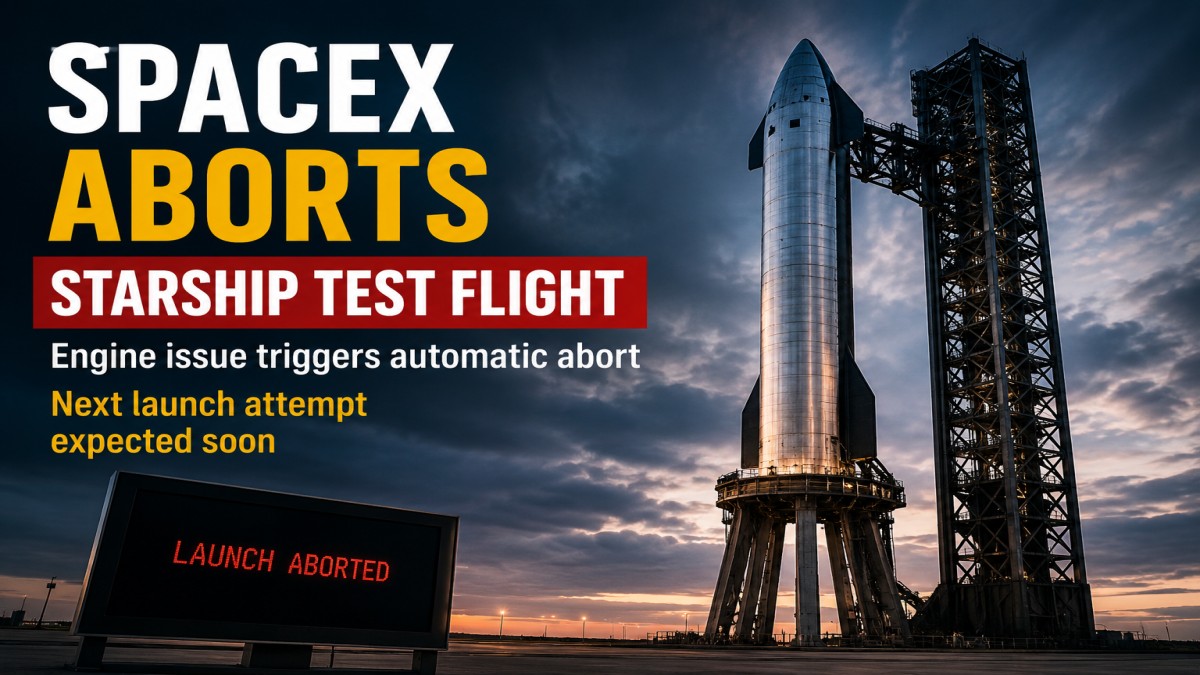
SpaceX postponed the highly anticipated debut flight of its Starship V3 rocket after an automatic safety system stopped the launch sequence just before liftoff on Thursday evening.
The launch was scheduled from Starbase in South Texas, where the countdown entered its final moments before the booster detected an issue during engine ignition. The onboard system immediately canceled the launch to protect the vehicle and ground infrastructure.
The company ended the attempt within the opening minutes of its scheduled launch window, emphasizing that the abort was triggered by the rocket’s built-in safety systems.
Elon Musk Explains What Happened
SpaceX CEO Elon Musk later confirmed that not all of the rocket’s Raptor engines started correctly during ignition.
According to Musk, engineers plan to remove and replace two Raptor engines before scheduling another flight attempt. He indicated that, if inspections go as planned, the company could try launching again early next week.
Automatic launch aborts are common during rocket development and are designed to prevent hardware damage or potential safety risks before liftoff.
Stock Reacts to Launch Delay
The delayed launch weighed on investor sentiment.
SpaceX shares declined more than 3% in extended trading, continuing a recent downward trend following the company’s record-breaking public market debut. The stock has recently traded below its $135 IPO price, reflecting investor caution despite strong long-term growth expectations.
Although the launch delay affected short-term market confidence, analysts note that development setbacks are typical in large-scale space programs.
Starship V3 Is a Major Upgrade
Starship V3 represents the newest version of SpaceX’s fully reusable launch system and includes multiple improvements designed to increase reliability and payload capability.
The mission was expected to deploy 20 next-generation Starlink satellites, allowing SpaceX to test upgraded satellite technology while demonstrating the rocket’s operational capabilities.
The satellites were also planned to conduct brief in-orbit testing before safely reentering Earth’s atmosphere.
FAA Recently Cleared Starship to Fly
The launch attempt came only days after the Federal Aviation Administration (FAA) completed its review of issues from a previous Starship flight.
Investigators concluded that heat-related effects on propulsion components and engine monitoring settings likely contributed to the earlier booster failure. Following SpaceX’s corrective actions—including hardware and software improvements—the FAA approved the company to resume flight testing.
Those upgrades are intended to improve booster performance during future missions.
Why This Mission Matters
The Starship program plays a critical role in SpaceX’s long-term strategy.
The giant rocket is expected to:
- Launch larger batches of Starlink satellites.
- Support future commercial space missions.
- Serve as NASA’s lunar landing vehicle for upcoming Artemis missions.
- Eventually transport cargo and astronauts on deep-space missions.
Each successful test flight provides valuable engineering data that moves the program closer to routine operational service.
What’s Next?
Engineers will now complete inspections and replace the affected engines before preparing the vehicle for another launch attempt.
If all technical reviews are completed successfully, SpaceX could conduct the next Starship V3 test flight early next week. While the delay disappointed spectators and investors, the company’s cautious approach highlights its focus on safety and long-term reliability as it continues developing the world’s most powerful launch system.
Article Credit:
Reporting based on publicly available information from SpaceX, Elon Musk, and the U.S. Federal Aviation Administration (FAA). The article has been independently rewritten and edited by the S24Bulletin editorial team.
Image Credit
AI-generated illustration created by ChatGPT (OpenAI) for editorial purposes. The image is a conceptual representation and not an actual photograph of the event.